Yes, you can get a mortgage on a loft in Ontario, and most hard and soft lofts are financed exactly like any other condo apartment, including with insured mortgages from 5% down. Lenders do look harder at a few loft quirks: live/work units with a commercial tax class, very small or unusual layouts, older converted buildings and one-of-a-kind units that are hard to appraise. Knowing those checks in advance is what keeps a firm deal from turning into a scramble.
Key takeaways
- A loft registered as a residential condo unit is a condo apartment to most lenders.
- Live/work units can be harder if part of the unit is zoned or assessed as commercial.
- Lofts priced at $1.5 million or more can’t be insured, so you need at least 20% down.
- Unique units carry more appraisal risk; keep a cash buffer.
- Ask a broker to pre-clear the building before you make an offer.
How lenders see a loft
To a lender, “loft” is a marketing word. What matters is what’s registered on title and how the unit is used. A unit in a registered residential condominium corporation, whether it’s in a 1910 knitting mill or a 2019 concrete mid-rise, is underwritten as a condo apartment.
That means the usual tests apply: your income and debts, your credit, the property’s value and the health of the condo corporation. The differences show up at the edges, and lofts live at the edges more than most property types do.
Live/work lofts, zoning and the commercial tax question
Some lofts, especially in older conversions, are marketed as live/work units. Lenders want to know whether the unit is residential with a home business, or partly commercial.
The property tax bill often tells you. MPAC can place a property in more than one class: its classification fact sheet notes that some properties belong to more than one class, and the class sets the tax rate. In Toronto the difference is large. The 2026 total tax rate is 0.767311% for residential and 2.301986% for commercial.
On a unit assessed at $600,000, fully residential, that’s about $4,604 a year. If a quarter of the assessed value were classed commercial, it would be roughly $6,906. Lenders count property tax in your debt ratios, so a higher bill also reduces how much you can borrow.
Why some lenders hesitate
- A meaningful commercial component can push the file toward commercial lending rules, with bigger down payments.
- Default insurers are built around residential use, so a unit that looks commercial may not fit.
- Resale demand for mixed-use units can be thinner, which affects the appraisal.
Plenty of live/work lofts are financed every year. The point is to check the tax bill, the zoning and the condo declaration before you commit, not after.
Open-concept and bachelor lofts
A loft without an enclosed bedroom is common, and lenders don’t object to an open plan in itself. The questions are about size and resale. Some lenders and insurers set minimum unit sizes or apply tighter rules to very small studios, and those policies vary and change. A broker who places loft files regularly will know which lenders are comfortable with a 450-square-foot open unit and which aren’t.
If you’re looking at a tiny unit, ask your broker before you fall for it. The rate may be the same, but the list of lenders willing to fund it may be shorter.
Older buildings, reserve funds and the status certificate
Hard lofts are by definition older buildings with new uses. Windows, masonry, roofs and mechanical systems eventually need major money. A thin reserve fund or an upcoming special assessment doesn’t usually block a mortgage, but it affects your budget and sometimes the lender’s view of the building.
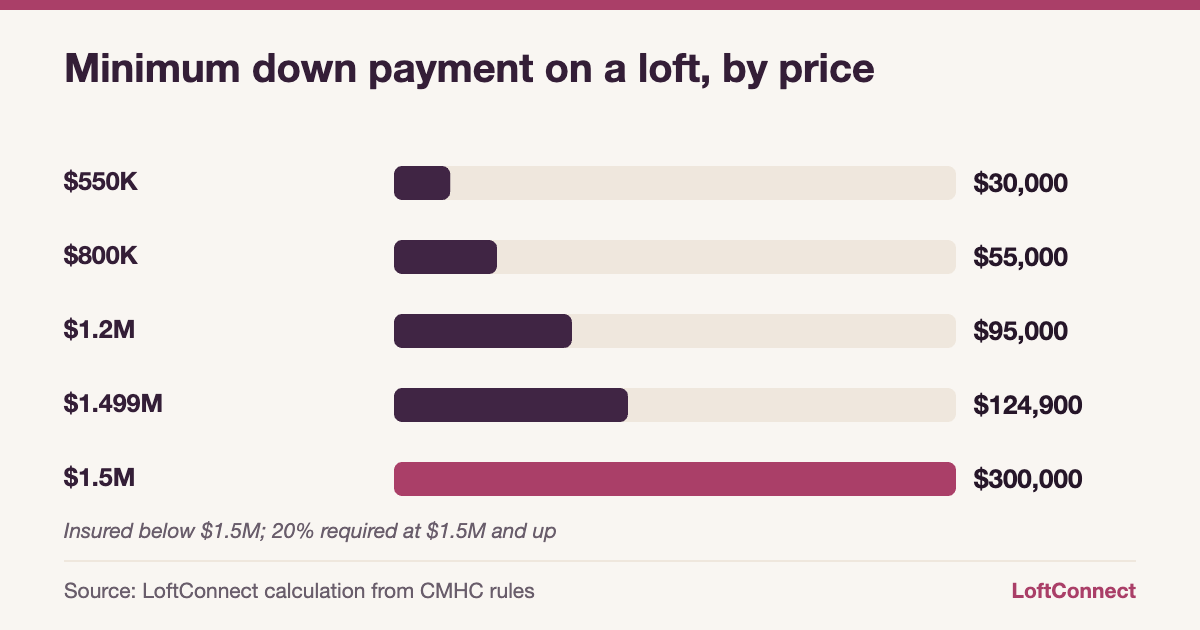
Your lawyer reviews the status certificate, which the corporation must deliver within 10 days for no more than $100, per the Condo Authority of Ontario. Our status certificate guide walks through the reserve fund study, budget, insurance and any legal claims.
Down payment, insurance and the $1.5 million line
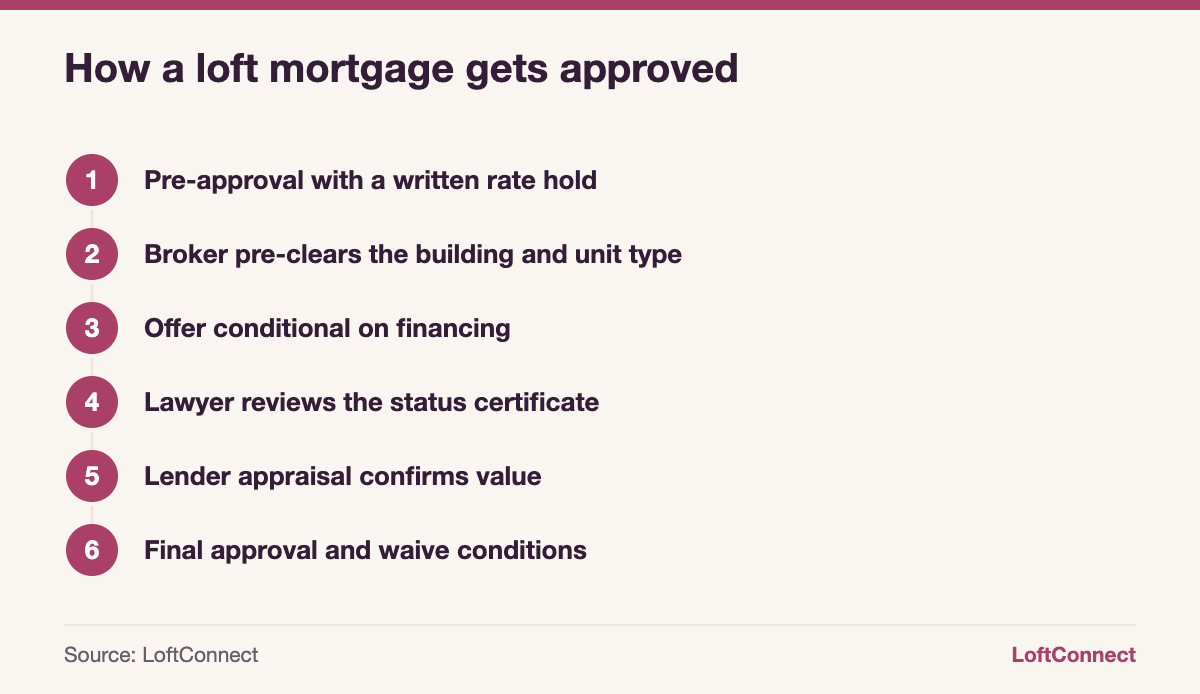
Insured mortgages need 5% of the first $500,000 and 10% of the portion above that, up to a $1.5 million price cap. At $1.5 million or more, default insurance isn’t available, so the minimum is 20%. First-time buyers and buyers of newly built homes can get a 30-year insured amortization; everyone else on an insured mortgage is limited to 25 years.
| Loft price | Minimum down payment | As % of price |
|---|---|---|
| $550,000 | $30,000 | 5.45% |
| $800,000 | $55,000 | 6.88% |
| $1,200,000 | $95,000 | 7.92% |
| $1,499,000 | $124,900 | 8.33% |
| $1,500,000 | $300,000 | 20.00% |
Big penthouse and two-storey hard lofts in Toronto sometimes cross $1.5 million, and the down payment jumps by $175,100 at that threshold. Source: CMHC purchase rules.
The stress test still applies
You qualify at the greater of your contract rate plus 2% or 5.25%. With fixed rates rising this fall, our note on the Bank of Canada’s October 28 decision shows how much a quarter-point changes the payment on a typical loft.
Appraisals on one-of-a-kind units
Lenders lend on the lower of the price and the appraised value. Appraisers rely on comparable sales, and a corner hard loft with 14-foot ceilings and a private terrace may have only a handful of true comparables. If the appraisal comes in low, you cover the gap in cash or renegotiate.
Practical defences: keep your financing condition until the appraisal is done, give the appraiser a list of recent sales in the building, and don’t stretch to your absolute maximum on a unique unit.
Self-employed creatives and alternative lenders
Lofts attract designers, photographers and other self-employed buyers, and income documentation is where many loft files actually stall. Big banks generally want two years of tax returns and Notices of Assessment. If your income is new, seasonal or heavily written down, an alternative lender may approve you, usually at a higher rate and with fees, with the plan to refinance later. Weigh that cost honestly.
A document checklist for your loft mortgage
- Two years of Notices of Assessment and T1 Generals if you’re self-employed; recent pay stubs and an employment letter if you’re salaried.
- Proof of down payment, with 90 days of account history.
- The listing, including the legal description and the parking and locker details.
- The latest property tax bill, to confirm the tax class.
- The condo fee amount and what it includes.
- The status certificate, once ordered.
- Any live/work or commercial-use details from the declaration.
Tip: Before you offer on a loft in an older conversion or a live/work building, ask your broker to run the address past two or three lenders. It takes a day, costs nothing, and tells you whether you’re shopping in a building with a full menu of lenders or a short one.
Frequently asked questions
Can you get a CMHC-insured mortgage on a loft?
Yes, if the loft is a residential unit priced under $1.5 million and you meet the usual rules on credit, income and debt ratios. Insurance is available through CMHC and the private insurers. Units with a significant commercial component or an unusual title may not qualify, so confirm before you firm up an offer.
Do lenders finance live/work lofts?
Many do. A live/work loft that is a residential condo unit with a home business is usually treated like any condo. The harder files are units where part of the space is zoned or assessed as commercial. Check the tax bill and the condo declaration, and ask a broker to pre-clear the unit.
Is it harder to get a mortgage on a bachelor loft?
It can be for very small units. An open plan isn’t a problem by itself, but some lenders and insurers apply minimum size rules or extra scrutiny to small studios, and those rules vary by lender. A unit that’s comfortably sized and has recent sales in the building is usually straightforward.
How much do I need to put down on a $1.5 million loft?
At least $300,000, or 20%, because homes priced at $1.5 million or more can’t be insured. Just below the line, at $1,499,000, the minimum is $124,900. That’s why pricing and negotiation around $1.5 million matter so much for larger hard lofts and penthouses.
Shopping with financing in mind
Browse hard lofts or all lofts for sale in Ontario, and use our loft buyer calculators to test payments at the stress-test rate before you book showings. If you’re considering a new building, see how the enhanced HST rebate on new soft lofts changes the math.
This article is general information as of October 2026, not legal, tax, mortgage or financial advice. Rules and numbers change, so confirm the details for your situation with a licensed professional.