The Bank of Canada announces its next rate decision on Wednesday, October 28, 2026, at 9:45 a.m. ET. Its policy rate has sat at 2.25% all year, but the Bank warned in September that upside risks to inflation had increased, and some analysts now think a hike is possible before year-end. If you are shopping for a loft, the practical move is to lock in a pre-approval rate hold now, because fixed mortgage rates have already started rising without waiting for the Bank.
Key takeaways
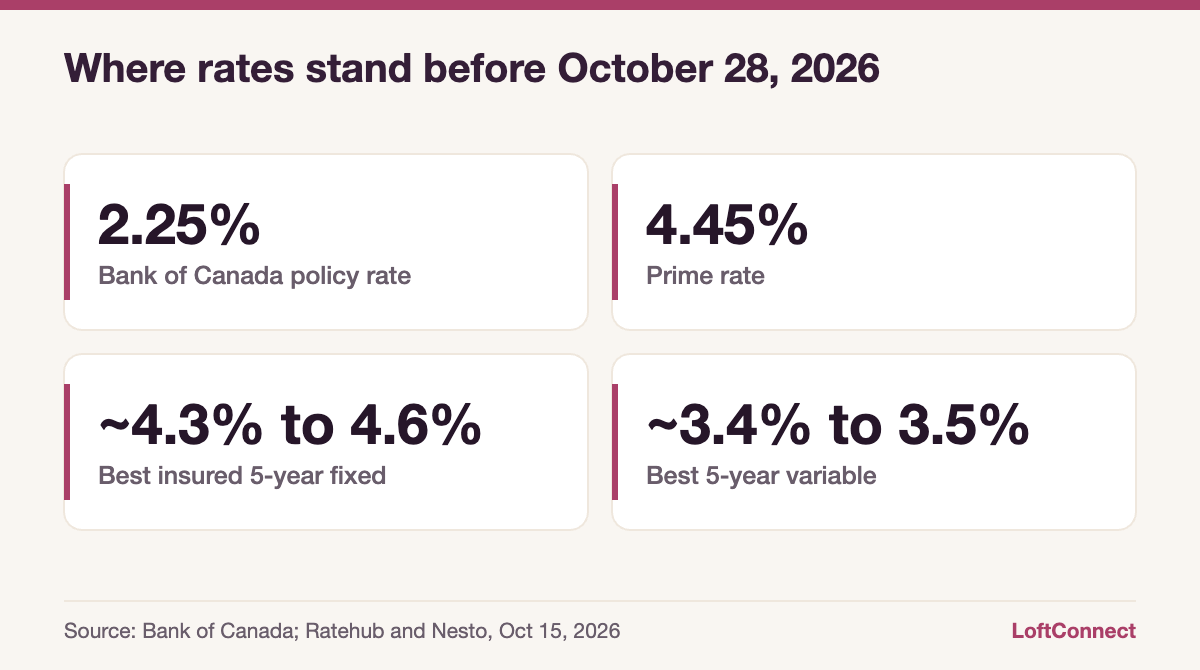
- The policy rate is 2.25% and prime is 4.45%, both unchanged since October 2025.
- All six big banks raised fixed rates between September and mid-October 2026, ahead of any Bank of Canada move.
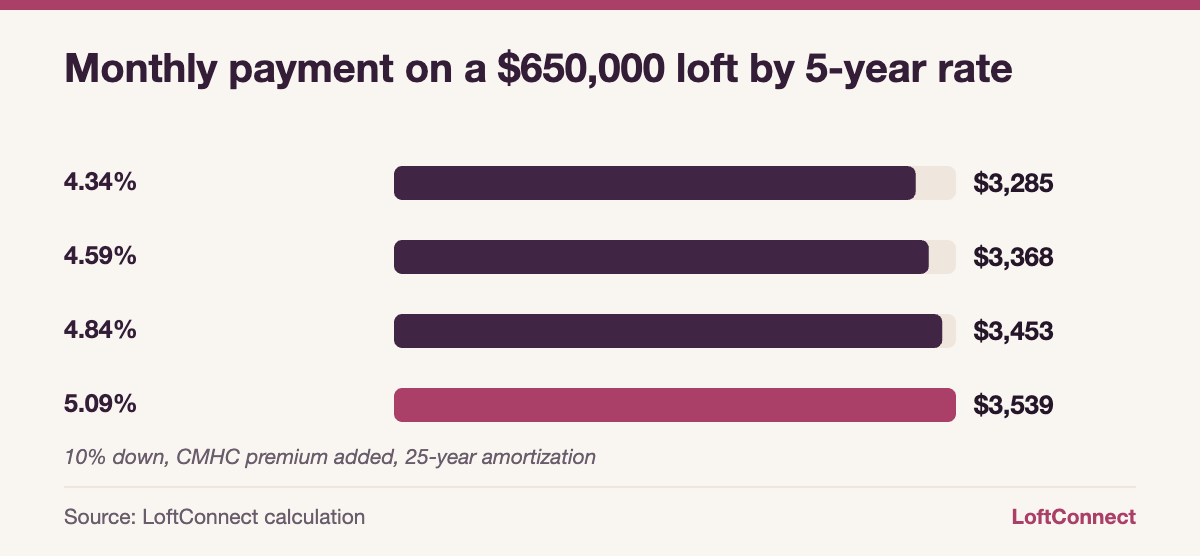
- On a $650,000 loft with 10% down, each quarter-point adds about $85 to the monthly payment.
- A rate hold costs nothing and protects you if rates jump while you look.
- Lofts bring extra risks (appraisals, condo fees, older buildings) that matter more when rates are tight.
Where mortgage rates stand before the October 28 announcement
The Bank of Canada cut its policy rate to 2.25% on October 29, 2025, and has held at every 2026 meeting since, most recently on September 2. Its two remaining 2026 decisions are October 28 and December 9. The October date comes with a Monetary Policy Report, so expect more detail than usual on the Bank’s inflation outlook.
Prime is 4.45%. As of October 15, the best discounted rates we could find were roughly:
- 5-year fixed, insured: about 4.3% to 4.6%
- 5-year fixed, uninsured: around 5.1% at some lenders
- 5-year variable: about 3.4% to 3.5%, or roughly prime minus 1%
Comparison sites disagree, and your rate depends on your down payment, credit and property. Treat these as a range, not a quote.
Why fixed rates are rising before the Bank moves
Fixed mortgage rates follow Government of Canada bond yields, not the overnight rate. The 5-year yield hit a 52-week high of 3.729% on September 28, and lenders responded. BMO, for example, moved its 5-year fixed to 5.14% uninsured and 4.99% high-ratio on October 7.
So even if the Bank holds on October 28, fixed rates can keep drifting up if bond markets expect inflation to stay sticky. A hike would mostly hit variable-rate borrowers and anyone on a line of credit, because those float with prime.
What a quarter-point means on a $650,000 loft
Here is the arithmetic for a typical Toronto loft purchase: $650,000 with 10% down ($65,000). The minimum down payment at that price is actually $40,000 (5% of the first $500,000 plus 10% of the rest), but 10% is a common target.
- Mortgage before insurance: $585,000
- CMHC premium at 90% loan-to-value (3.10%): $18,135, added to the loan
- Ontario sales tax on the premium (8%): $1,450.80, paid in cash at closing
- Total insured mortgage: $603,135 over 25 years
| 5-year fixed rate | Monthly payment | Change vs 4.34% |
|---|---|---|
| 4.34% | $3,284.75 | none |
| 4.59% | $3,368.43 | +$83.68 |
| 4.84% | $3,453.13 | +$168.38 |
| 5.09% | $3,538.83 | +$254.08 |
Payments assume semi-annual compounding, the Canadian standard for fixed mortgages. Your lender’s figures may differ by a few dollars.
The stress test matters more than the payment
You don’t qualify at your contract rate. Under the OSFI minimum qualifying rate, uninsured borrowers qualify at the greater of their rate plus 2% or 5.25%, and insured borrowers face the same test. At a 4.34% contract rate you qualify at 6.34%, a payment of about $3,981.62 on the mortgage above. If rates rise half a point before you’re approved, your maximum purchase price shrinks with them.
Rate holds: the cheapest protection you can get
Most lenders will hold a rate for a set period after pre-approval, often 90 to 120 days depending on the lender. If rates rise, you keep the held rate. If they fall, a good broker will move you to the lower one.
A few details trip up loft buyers:
- The hold covers closing, not just the offer. Resale lofts often close 60 to 90 days out. If your hold expires before closing, it doesn’t help.
- Holds are conditional. The lender still has to approve the specific unit, and some lenders are pickier about live/work units, very small units or older conversions.
- Get it in writing. Ask for the rate, the expiry date and the product (fixed or variable) on the pre-approval.
Fixed or variable for a loft purchase this fall?
On the mortgage above, a 3.45% variable rate would cost about $2,995.38 a month, roughly $289 less than a 4.34% fixed. That gap is the reason variable still tempts people.
The trade-off is direct exposure to the Bank of Canada. With a spread of about 0.9 percentage points (4.34% minus 3.45%), it would take three or four quarter-point increases in prime before a variable borrower pays what a fixed borrower locks in today. Nobody can promise that won’t happen, but it is a useful way to frame the decision.
Questions to ask yourself
- Could you absorb a payment $200 to $300 higher without stress?
- Does the building have a thin reserve fund or a special assessment on the horizon? Older hard lofts sometimes do, and that argues for payment certainty.
- Will you likely sell or refinance within three to five years? Penalties on variable mortgages are usually smaller.
Loft-specific checks while rates are moving
Rate pressure magnifies problems that are already common with lofts. Our nine-point loft buying checklist covers the building side; on the financing side, watch these:
- Appraisals. A one-of-a-kind hard loft has fewer comparable sales, so the lender’s appraisal can come in below your price. You cover any gap in cash.
- Condo fees. Lenders count condo fees when calculating your debt ratios, and loft fees are often higher than in newer towers. A $900 fee reduces your borrowing power more than a $500 fee.
- The status certificate. Review it before you firm up. Our status certificate guide explains what to look for, including the reserve fund and any lawsuits.
- Amortization. First-time buyers can get a 30-year insured mortgage through CMHC Home Start. The premium is 0.20% higher (3.30% here, or $19,305), but the payment at 4.34% drops to about $2,990.98.
A pre-October 28 checklist for loft buyers
- Get a written pre-approval with a rate hold that runs past your likely closing date.
- Ask your broker which lenders on your file accept the loft types you’re considering.
- Run your numbers at the stress-test rate, including realistic condo fees and property tax.
- Decide in advance how you’d respond to a hike: lower your price ceiling, increase your down payment, or keep looking.
- Keep an extra buffer for an appraisal shortfall on unusual units.
- Check recent loft sales in the buildings you like with our loft buyer calculators and the latest October loft market report.
Tip: If you’re bidding on a hard loft in an older conversion, ask your broker to pre-clear the building with the lender before you write an offer. A rate hold is only useful if the lender will actually finance that address, and finding out after a firm deal is expensive.
Frequently asked questions
Will the Bank of Canada raise rates on October 28, 2026?
Nobody knows for certain. The Bank has held at 2.25% throughout 2026, but in September it said upside risks to inflation had increased, and some analysts think a hike is possible at the October or December meeting. Plan for both outcomes rather than betting on one.
Does the Bank of Canada decision change fixed mortgage rates?
Not directly. Fixed rates track Government of Canada bond yields, which react to inflation expectations. That’s why the big banks raised fixed rates in September and October 2026 while the policy rate stayed put. A Bank hike changes prime, which moves variable rates and lines of credit immediately.
Should I wait until after October 28 to buy a loft?
Waiting only helps if rates fall, and fixed rates were rising in October. A better approach is to get a rate hold now and keep shopping. If the Bank holds and bond yields ease, you may get a lower rate. If rates rise, your hold protects you until it expires.
What is the mortgage stress test rate in 2026?
Borrowers qualify at the greater of their contract rate plus two percentage points or 5.25%. At a 4.34% fixed rate, that means qualifying at 6.34%. Insured borrowers face the same test, though straight switches to a new lender at renewal are exempt if the loan amount and amortization don’t increase.
Ready to shop before rates move?
Browse current Toronto lofts for sale with your rate hold in hand, and set a price ceiling based on the stress-test payment, not the contract one.
This article is general information as of October 2026, not legal, tax, mortgage or financial advice. Rules and numbers change, so confirm the details for your situation with a licensed professional.