
A live/work loft is a unit where you both live and run a business, studio or practice. In Toronto the label covers very different things: an ordinary residential unit where you work from home, a unit in a building whose zoning and condo declaration allow work uses, or simply a listing term for a big open space. Which one you’re buying decides your property tax class, your mortgage options and what your business can actually do there.
Key takeaways
- “Live/work” is not a single legal category; check zoning, the condo declaration and the tax bill.
- Toronto’s zoning by-law allows home occupations in a dwelling unit that is the operator’s principal residence.
- Part of a unit can be assessed as commercial, and Toronto’s commercial tax rate is about three times the residential rate.
- Lenders finance most residential live/work lofts normally; commercial components complicate things.
- Claiming home-office expenses is possible, but think about the principal residence exemption before claiming depreciation.
What “live/work” means in Toronto
Many of Toronto’s hard lofts sit in former industrial districts that were opened to residential uses in the 1990s and 2000s. Some of those buildings were pitched to artists and small firms who wanted one space for living and making things, and the term stuck.
Today you’ll see “live/work” on three kinds of listings:
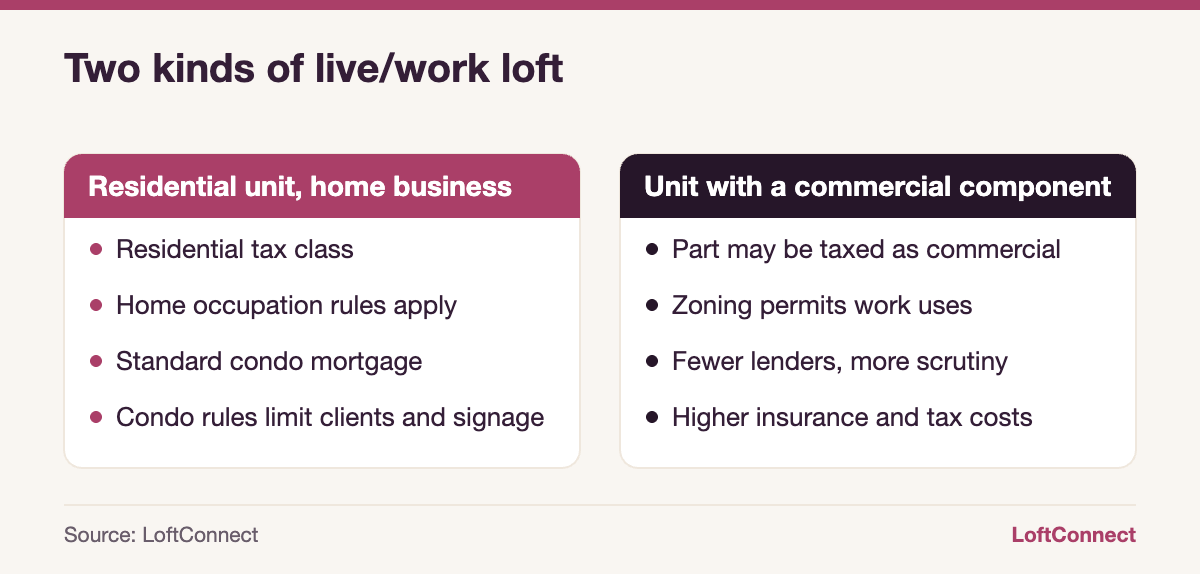
- Residential units with work potential. The large majority. They’re residential condo units, and the business use is a home occupation.
- Units with permitted work uses. The zoning and declaration allow a defined commercial or studio use, sometimes with a separate street entrance. Some are assessed partly as commercial.
- Marketing labels. Big, open units described as live/work because a desk fits nicely by the window.
Zoning: home occupation vs commercial use
Toronto’s city-wide Zoning By-law 569-2013 defines a home occupation as a business use within a dwelling unit, where that unit is the business operator’s principal residence. You can read the definitions in Chapter 800 of the by-law. The by-law then sets out which home occupations are allowed and the conditions that apply, so a graphic designer working at a desk is a very different case from a business with staff and walk-in customers.
Some older loft buildings are also governed by site-specific zoning that predates the city-wide by-law. If a listing promises a particular commercial use, ask for written confirmation: a zoning certificate or a zoning review from the City, or a lawyer’s opinion based on the building’s zoning.
The condo declaration and rules decide the day-to-day
Even where zoning allows a business, the condominium’s declaration and rules can restrict it. Common limits include:
- No exterior signage, or signage only in approved places.
- Limits on clients, deliveries or employees coming and going.
- Restrictions on noise, odours, kilns, compressors or heavy equipment.
- Requirements to carry extra insurance for business use.
Your lawyer will review the declaration with the status certificate. Our status certificate guide explains what else to read, including the reserve fund and any special assessments.
Property tax: does a live/work loft pay commercial rates?
Usually not, but it can. MPAC’s classification fact sheet says some properties belong to more than one class, with the example of a residential unit above a shop. The class sets the tax rate.
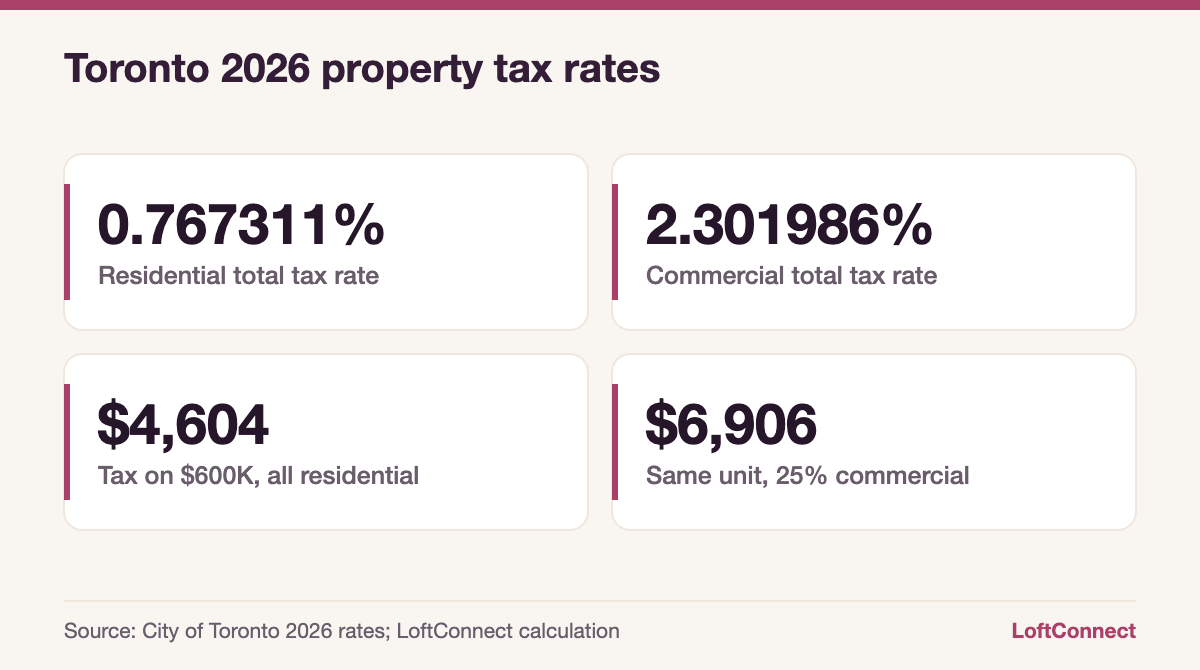
In Toronto’s 2026 rates, the total residential rate is 0.767311% and the commercial rate is 2.301986%. On a loft assessed at $600,000:
| Scenario | Residential portion | Commercial portion | Annual tax |
|---|---|---|---|
| Fully residential | $600,000 | $0 | $4,603.87 |
| 25% classed commercial | $450,000 | $150,000 | $6,905.88 |
That’s about $2,302 a year more, before any change in insurance or condo fees. Look at the current tax bill and the MPAC property assessment notice for the unit, not just the listing.
Mortgages and insurance on live/work units
A residential condo unit where you work from home is financed like any other condo. The harder files are units with a commercial component or unusual title, because default insurers and many lenders are built around residential use. We cover this in detail in what lenders look for in a loft mortgage.
Insurance follows the same logic. A standard condo unit owner’s policy may limit or exclude business property and liability for clients who visit. Tell your insurer what you do in the space and get any business coverage in writing.
Income tax: home office expenses and your principal residence
If you’re self-employed and the loft is your principal place of business, or you use a defined area only for business and regularly meet clients there, you may be able to deduct a share of costs such as condo fees, utilities, insurance and property tax. Talk to an accountant about how the area is measured and documented.
Be careful with depreciation. The CRA’s principal residence folio discusses when business use of part of a home affects the exemption. Claiming capital cost allowance on the business portion can put part of your future gain outside the exemption. For many loft owners, the tax on that gain later outweighs the deduction now.
Who live/work lofts suit, and who they don’t
They tend to work well for:
- Designers, architects, writers, consultants and developers who need room more than foot traffic.
- Photographers and video producers who value high ceilings and big windows, as long as clients and gear movements fit the condo rules.
- Therapists or coaches with occasional, scheduled visitors, where the declaration allows it.
They tend to disappoint businesses that need walk-in customers, signage, several employees, or noisy and dusty processes. Those uses generally belong in commercial space.
A live/work loft checklist before you offer
- Read the current property tax bill and confirm the tax class.
- Ask the seller or listing agent for anything in writing about permitted work uses.
- Have your lawyer review the declaration, by-laws and rules for business restrictions.
- Confirm zoning for your specific use, ideally with a zoning certificate or professional opinion.
- Ask your mortgage broker to pre-clear the unit with lenders.
- Get an insurance quote that covers your business activity.
- Talk to an accountant about home office deductions and the principal residence exemption.
Tip: Ask the condo manager how many owners in the building actually run businesses from their units, and whether the board has had complaints. A building where a dozen owners already work from home is a very different place from one where you’d be the first.
Frequently asked questions
Can I run a business from my Toronto condo loft?
Often yes, as a home occupation, if the loft is your principal residence and the business fits the zoning by-law’s conditions. The condo declaration and rules can add limits on clients, employees, signage and noise. Check both before you buy, and get written confirmation if your business depends on a particular use.
Do live/work units pay commercial property tax?
Most residential live/work lofts are taxed at the residential rate. MPAC can classify part of a property as commercial, and in Toronto the 2026 commercial rate is about three times the residential rate. The current tax bill and assessment notice for the unit will show how it’s classed.
Can clients visit a live/work loft?
It depends on the condo’s rules and the zoning. Many buildings allow occasional, scheduled visitors but restrict steady client traffic, deliveries or employees. If client visits are central to your business, have your lawyer confirm what the declaration and rules allow before you waive conditions.
Can I deduct loft expenses if I work from home?
Self-employed owners may deduct a share of home costs if the space is their principal place of business, or is used only for business and regularly for meeting clients. Claiming depreciation on the business portion can affect your principal residence exemption, so get accounting advice first.
Find a loft that works as hard as you do
Browse Toronto lofts for sale or explore loft buildings by neighbourhood. Many of the best live/work spaces are hard lofts in converted industrial buildings.
This article is general information as of October 2026, not legal, tax, mortgage or financial advice. Rules and numbers change, so confirm the details for your situation with a licensed professional.
The newest lofts on the market
Fresh listings, updated every 15 minutes.
 $850,000211 - 625 Queen Street E, Toronto2+1 bed · 2 bath · South RiverdaleCourtesy of CHESTNUT PARK REAL ESTATE LIMITED
 $549,900624 - 200 Manitoba Street, Toronto1+1 bed · 2 bath · MimicoCourtesy of RE/MAX HALLMARK REALTY LTD.
 $729,900603 - 569 King Street E, Toronto1+1 bed · 1 bath · Moss ParkCourtesy of ROYAL LEPAGE REALTY PLUS
 $534,000216 - 8 Dovercourt Road, Toronto1 bed · 1 bath · Little PortugalCourtesy of SAGE REAL ESTATE LIMITED
 $824,900310 - 45 Dovercourt Road, Toronto1+1 bed · 1 bath · NiagaraCourtesy of CENTURY 21 PEOPLE`S CHOICE REALTY INC.
 $499,990528 - 65 East Liberty Street, Toronto1 bed · 1 bath · NiagaraCourtesy of HOMELIFE/MIRACLE REALTY LTD