As a cash-flow investment, most Toronto lofts are not a good buy in 2026: with uninsured 5-year fixed rates around 5% and average GTA condo rents near $2,568, a typical financed loft loses money every month. Lofts can still make sense if you’re buying for long-term appreciation with a large down payment, if you plan to live in the unit later, or if you’re buying a genuine hard loft, a type of property nobody is building more of. Go in for those reasons, with the numbers in front of you, not for rental income.
Key takeaways
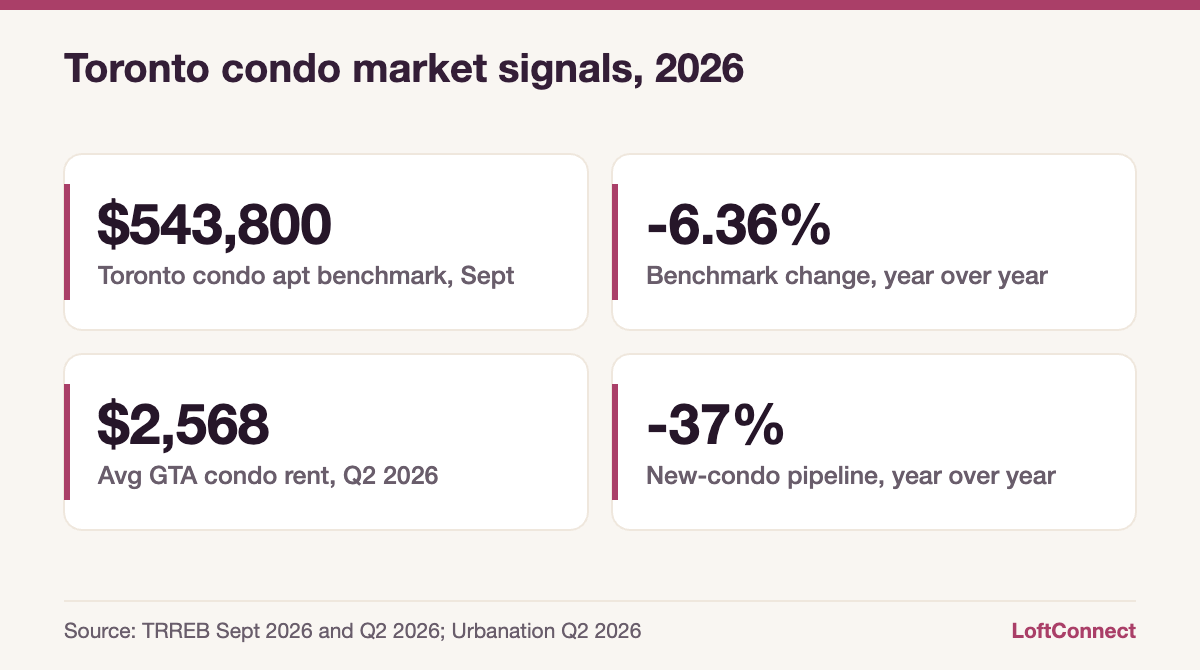
- The City of Toronto condo apartment benchmark was $543,800 in September 2026, down 6.36% from a year earlier.
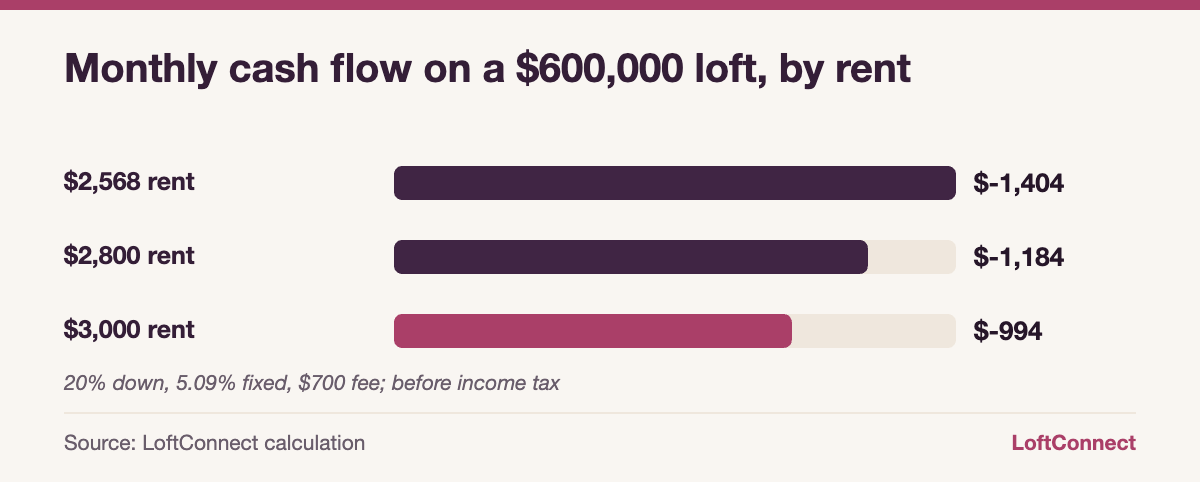
- On a $600,000 loft with 20% down, rents of $2,568 to $3,000 leave a monthly shortfall of roughly $994 to $1,404.
- Gross returns (cap rates) of about 3% to 3.6% are below today’s borrowing costs.
- Hard lofts are a fixed supply, and the new-condo pipeline is shrinking.
- Most hard lofts are under rent control; many soft lofts built after 2018 are not.
Where Toronto condo prices and rents stand in 2026
There’s no official benchmark for lofts alone, so the condo apartment numbers are the closest guide. According to TRREB’s September 2026 MLS HPI tables, the City of Toronto condo apartment benchmark was $543,800, down 6.36% year over year. In the downtown C01 district, home to King West, Liberty Village and many converted warehouses, it was $550,600, down 6.88%.
Rents have softened too. TRREB’s Q2 2026 condo report put the average GTA condo rent at $2,568, down 1.9%. It also said conditions are tightening and could lay the foundation for price growth in 2027, which is a forecast, not a promise.
Do lofts cash-flow in Toronto? A worked example
Here is a deliberately ordinary scenario: a $600,000 loft bought as a rental with 20% down.
- Mortgage: $480,000 at 5.09% fixed (a typical uninsured rate in mid-October), 25 years: $2,816.35 a month
- Condo fee: $700 a month (an assumption; check the actual unit)
- Property tax: $287.74 a month, assuming an assessed value of $450,000 at Toronto’s 2026 residential rate of 0.767311%
- Insurance: $40 a month
- Vacancy and repairs allowance: 5% of rent
| Monthly rent | Total monthly costs | Monthly cash flow | Cap rate |
|---|---|---|---|
| $2,568 | $3,972.49 | -$1,404.49 | 2.82% |
| $2,800 | $3,984.09 | -$1,184.09 | 3.26% |
| $3,000 | $3,994.09 | -$994.09 | 3.64% |
Break-even rent in this example is about $4,046 a month, well above what most units of this price rent for. The cap rate (net operating income divided by price, before financing) of roughly 3% to 3.6% is lower than the mortgage rate, so borrowing makes the return worse, not better.
What the example leaves out
Your tenant does pay down principal: about $9,844 in year one on this mortgage. That softens the picture, but the cash shortfall in the example is $11,929 to $16,854 a year, so you are still behind before any change in value. Income tax treatment, interest deductibility and your own rate will change the numbers, so run yours with an accountant.
Why hard lofts behave differently from regular condos
The investment case for hard lofts is about scarcity. Nobody is building new 100-year-old factories, and genuine conversions are limited by the stock of suitable industrial buildings in the right neighbourhoods. A buyer who specifically wants brick, timber beams and 12-foot ceilings has a short list of buildings to choose from.
That doesn’t make hard lofts immune to market cycles. It means they compete less directly with the thousands of new glass-tower units hitting the market. Soft lofts, which are newer buildings with loft features, sit closer to the regular condo market. Our hard loft vs soft loft explainer covers the differences.
The supply pipeline is shrinking
Urbanation reported no new GTHA condo project launches for two straight quarters, 11,653 units cancelled since 2024, and pre-construction plus under-construction inventory down 37% year over year, as reported by Canadian Mortgage Professional. Fewer completions later this decade could support resale prices. At the same time, a record 5,001 completed units are still unsold today, which caps prices in the short run.
Rent control, vacancy tax and other rules for loft landlords
- Rent control. Ontario exempts units first occupied for residential purposes after November 15, 2018 from the annual rent increase guideline. Most hard lofts were converted well before then, so the guideline limits increases for sitting tenants. Many newer soft lofts are exempt.
- Vacant Home Tax. Toronto charges 3% of assessed value on homes left vacant, and owners must declare occupancy every year. Leaving a loft empty between tenants for too long can be costly.
- Short-term rentals. Toronto only allows them in the operator’s principal residence, so an investment loft can’t be a full-time Airbnb.
- Condo rules. Some buildings restrict leasing terms; the declaration and rules will say.
When a loft can still be a sensible investment
- You’re putting down enough that the property carries itself, or close to it, and you’re comfortable with a low return in exchange for long-term appreciation.
- You plan to live in it within a few years, so the rental period is a bridge, not the business plan.
- It’s a well-run hard loft in a building with steady demand, a healthy reserve fund and limited competing supply.
- You’re buying from a motivated seller, a builder with unsold inventory or an estate, at a price that reflects today’s market.
- You can absorb a special assessment or a vacant month without stress.
Fees are where loft returns most often disappear, so read our breakdown of why loft condo fees vary before you set a budget, and check financing with what lenders look for in a loft mortgage.
Tip: Before buying a loft as a rental, look at how many units in the building are currently leased and listed for lease. If a dozen identical units are competing for tenants, your rent assumption is the first thing that breaks.
Frequently asked questions
Do lofts hold their value better than condos?
Genuine hard lofts tend to face less direct competition from new supply, because there is a limited stock of converted industrial buildings. That can help over the long run, but lofts still move with the broader market. Toronto condo benchmarks fell in 2026, and individual lofts can sell slowly because buyers for unique spaces are fewer.
Is it a good time to buy a loft in Toronto?
For an owner who plans to stay five years or more, softer prices and more negotiating room are real advantages. For an investor relying on rent to cover costs, the math is difficult in 2026. Decide which buyer you are, then judge the timing against your own finances rather than headlines.
What rent can a Toronto loft get?
It depends on size, location, parking and finishes. TRREB reported an average GTA condo rent of $2,568 in Q2 2026, and larger or more distinctive lofts may rent above that. Check recent leases in the same building, which your agent can pull, before relying on any figure.
Are lofts in Toronto rent controlled?
Units first occupied as homes on or before November 15, 2018 are subject to Ontario’s rent increase guideline for existing tenants. Most hard loft conversions fall into that group. Many newer soft loft units first occupied after that date are exempt. Your lawyer or the building’s history can confirm.
Thinking about a loft as a long-term hold?
Read the latest Toronto loft market report, then browse Toronto lofts for sale with your cash-flow numbers in hand.
This article is general information as of October 2026, not legal, tax, mortgage or financial advice. Rules and numbers change, so confirm the details for your situation with a licensed professional.
The newest lofts on the market
Fresh listings, updated every 15 minutes.
 $850,000211 - 625 Queen Street E, Toronto2+1 bed · 2 bath · South RiverdaleCourtesy of CHESTNUT PARK REAL ESTATE LIMITED
 $549,900624 - 200 Manitoba Street, Toronto1+1 bed · 2 bath · MimicoCourtesy of RE/MAX HALLMARK REALTY LTD.
 $729,900603 - 569 King Street E, Toronto1+1 bed · 1 bath · Moss ParkCourtesy of ROYAL LEPAGE REALTY PLUS
 $534,000216 - 8 Dovercourt Road, Toronto1 bed · 1 bath · Little PortugalCourtesy of SAGE REAL ESTATE LIMITED
 $824,900310 - 45 Dovercourt Road, Toronto1+1 bed · 1 bath · NiagaraCourtesy of CENTURY 21 PEOPLE`S CHOICE REALTY INC.
 $499,990528 - 65 East Liberty Street, Toronto1 bed · 1 bath · NiagaraCourtesy of HOMELIFE/MIRACLE REALTY LTD