
In a Toronto heritage loft, the Ontario Heritage Act mostly controls the building’s protected features, usually its exterior, while your condo corporation controls almost everything else. Inside your own unit you can typically renovate kitchens, bathrooms and finishes with condo approval, but windows, masonry, doors and anything visible from the street generally need both the corporation’s agreement and, in a designated building or district, a heritage permit. The key is knowing whether your building is designated or merely listed, and reading what the designation actually protects.
Key takeaways
- “Heritage” covers listed properties and designated properties, and only designation triggers heritage permits for alterations.
- Designation by-laws list specific heritage attributes; many focus on exteriors, but read yours.
- In a condo, windows, walls and roofs are usually common elements, so the corporation, not you, applies for changes.
- Listed properties not designated by January 1, 2027 must come off municipal registers under current provincial law.
- The King-Spadina Heritage Conservation District plan, adopted in 2017, remains under appeal at the Ontario Land Tribunal.
Listed vs designated: what “heritage loft” really means
Real estate listings use “heritage” loosely. Legally there are three different situations:
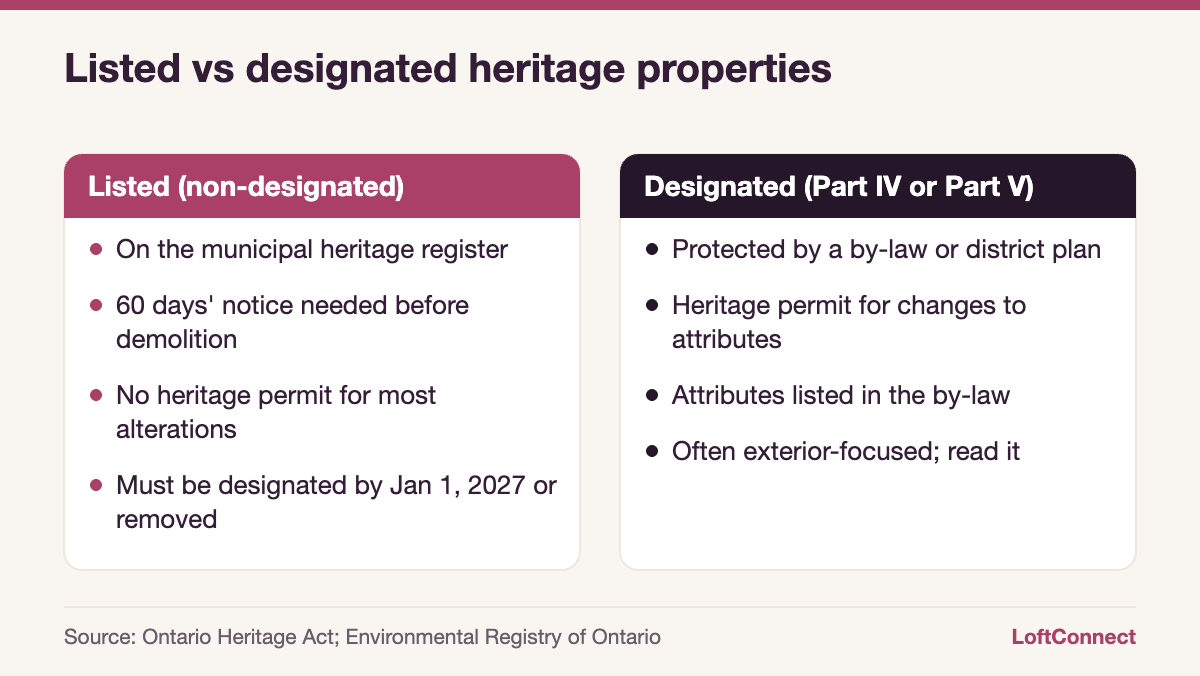
- Listed. The property is on the municipal heritage register but not designated. The main effect is that the owner must give 60 days’ notice before demolishing it, which gives council time to consider designation.
- Designated under Part IV. Council has passed a by-law designating the individual property, with a statement of its cultural heritage value and a list of heritage attributes.
- Inside a Heritage Conservation District (Part V). The property falls within a district with its own plan and guidelines.
Many converted warehouses in Toronto are in one of these categories, and some aren’t protected at all despite their age.
The January 1, 2027 deadline for listed properties
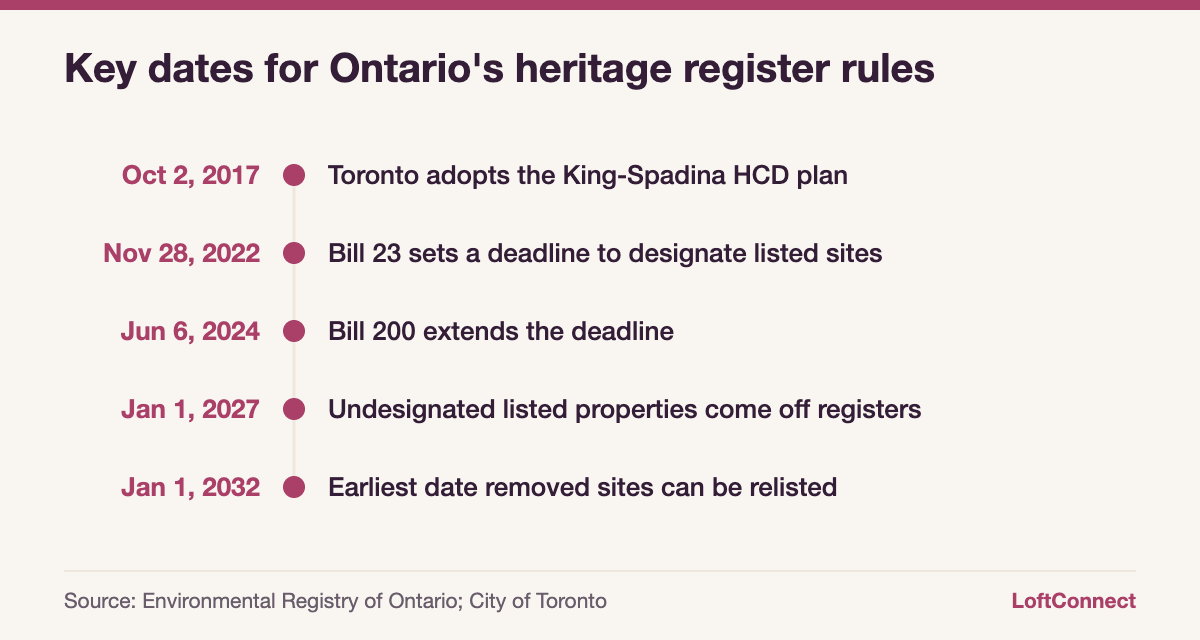
The province’s 2022 housing legislation (Bill 23) required municipalities to decide on properties that had been listed on their registers. Bill 200 then moved the deadline to January 1, 2027. According to the Environmental Registry of Ontario, any listed property without a notice of intention to designate by that date must be removed and can’t be relisted until January 1, 2032.
What it means for loft owners and buyers:
- Municipalities have been working through their registers and issuing notices of intention to designate for selected listed properties. A loft building could be designated in the coming months.
- Other listed buildings will simply drop off the register, which removes the demolition notice requirement.
- Several municipalities asked the province in 2026 to extend the deadline again. Unless that happens, January 1, 2027 stands.
If you’re buying in an older conversion this fall, ask your lawyer to check the property’s current heritage status and whether any notice of intention has been issued.
What a heritage designation controls
Under the Ontario Heritage Act, alterations likely to affect a designated property’s heritage attributes need a heritage permit from the municipality. The by-law defines what those attributes are: typical examples are the brick facade, window openings and their pattern, cornices, entrances, rooflines and painted signage.
Interiors are designated far less often, but it happens. A by-law could name a lobby, a staircase or interior features as attributes. Don’t assume; read the by-law, which your lawyer or the City can provide.
Heritage Conservation Districts and King-Spadina
In a district, the plan sets guidelines for changes to properties within the boundary, often focused on what’s visible from the public realm. The King-Spadina Heritage Conservation District, which covers much of the old garment and warehouse district between Simcoe and Bathurst, was adopted by Council on October 2, 2017. The City’s page says the plan is currently under appeal at the Ontario Land Tribunal, so check its status for any specific property.
What your condo corporation controls
Even without heritage rules, a loft owner’s freedom is set by the condo’s declaration, by-laws and rules. In most conversions:
| Element | Usually | Who decides |
|---|---|---|
| Windows and frames | Common elements | Corporation, plus a heritage permit if designated |
| Exterior masonry and roof | Common elements | Corporation, plus a heritage permit if designated |
| Exposed brick on the inside of exterior walls | Often common elements | Check the declaration |
| Kitchen, bathrooms, interior finishes | Part of the unit | Owner, with condo approval if rules require |
| Flooring | Part of the unit | Owner, subject to underlay and approval rules |
| Interior partitions | Part of the unit | Owner, with approval if they affect building systems |
Owner changes to common elements need board approval and usually a written agreement registered on title, as this summary of section 98 of the Condominium Act explains. We walk through that process in adding a bedroom to a loft.
Windows: the most common heritage loft question
Original steel or wood factory windows are often what makes a hard loft beautiful, and what makes it cold. Because they’re common elements, replacing them is a building-wide project funded by the reserve fund. In a designated building, the corporation needs a heritage permit that typically expects replacement windows to respect the original pattern, proportions and materials.
That can mean higher costs than standard replacements. It’s one reason heritage conversions sometimes carry higher fees, as covered in why loft condo fees vary. When you read a reserve fund study for a heritage building, look specifically at the window and masonry lines.
Buying a heritage loft: a checklist
- Confirm the building’s status: listed, designated (Part IV) or in a district (Part V).
- If designated, get the by-law and read the list of heritage attributes.
- Check for any notice of intention to designate issued in 2026.
- Review the reserve fund study for windows, masonry and roofing.
- Ask the manager about past heritage permits and how long approvals took.
- If you plan renovations, confirm what’s unit and what’s common element in the declaration.
- Ask your insurer whether the building’s age or materials affect your unit policy.
Tip: Ask for photos or drawings from the original conversion. Lofts converted decades ago sometimes have a documented record of what was kept, replaced or rebuilt, and that record is gold when the board, the City or a future buyer asks what’s original.
Frequently asked questions
Can I renovate the inside of a heritage loft?
Usually, yes. Most heritage designations protect exterior features, and interior renovations inside your unit are mainly governed by your condo’s rules. Some by-laws do name interior attributes, so read yours. Anything touching windows, exterior walls or common elements needs condo approval and possibly a heritage permit.
Does heritage designation lower a loft’s value?
There’s no simple answer. Designation limits some changes and can make major repairs costlier, which shows up in reserve fund planning. It also protects the character buyers pay for in a hard loft. Price depends far more on the unit, the building’s finances and the location than on designation alone.
What happens to listed heritage properties on January 1, 2027?
Under the Ontario Heritage Act as amended by Bill 200, listed properties without a notice of intention to designate by January 1, 2027 must be removed from municipal registers and can’t be relisted until January 1, 2032. Some municipalities have asked for another extension, so check for updates.
Who applies for a heritage permit in a condo loft?
For common elements like windows, masonry and roofs, the condo corporation applies, because it owns and maintains those elements. An owner who wants a change to a common element needs board approval first, often with a registered agreement. The municipality then decides whether to issue the heritage permit for work affecting designated attributes.
Find a loft with real history
Explore hard lofts in converted buildings and browse Toronto lofts for sale. Our Liberty Village guide covers one of the city’s best-known former industrial districts.
This article is general information as of October 2026, not legal, tax, mortgage or financial advice. Rules and numbers change, so confirm the details for your situation with a licensed professional.
The newest lofts on the market
Fresh listings, updated every 15 minutes.
 $850,000211 - 625 Queen Street E, Toronto2+1 bed · 2 bath · South RiverdaleCourtesy of CHESTNUT PARK REAL ESTATE LIMITED
 $549,900624 - 200 Manitoba Street, Toronto1+1 bed · 2 bath · MimicoCourtesy of RE/MAX HALLMARK REALTY LTD.
 $729,900603 - 569 King Street E, Toronto1+1 bed · 1 bath · Moss ParkCourtesy of ROYAL LEPAGE REALTY PLUS
 $534,000216 - 8 Dovercourt Road, Toronto1 bed · 1 bath · Little PortugalCourtesy of SAGE REAL ESTATE LIMITED
 $824,900310 - 45 Dovercourt Road, Toronto1+1 bed · 1 bath · NiagaraCourtesy of CENTURY 21 PEOPLE`S CHOICE REALTY INC.
 $499,990528 - 65 East Liberty Street, Toronto1 bed · 1 bath · NiagaraCourtesy of HOMELIFE/MIRACLE REALTY LTD