
Loft insurance works like condo insurance: the condo corporation’s master policy covers the building and units up to a defined “standard unit”, and your own unit owner’s policy covers your belongings, your upgrades, your liability and, often, your share of the corporation’s deductible. In older hard loft buildings the details matter more, because water leaks, original materials and high deductibles can turn a small incident into a large bill. Read the insurance certificate in the status package and get your own quote before you firm up.
Key takeaways
- The corporation insures the building and units as originally defined; you insure upgrades, contents and liability.
- Many declarations pass the corporation’s deductible to the owner of the unit where damage starts.
- Water damage is the issue to plan for in older buildings with original plumbing and roofs.
- High-end finishes and custom millwork usually need to be insured on your own policy.
- Tell your insurer about business use, rentals or vacancy.
How condo loft insurance is split
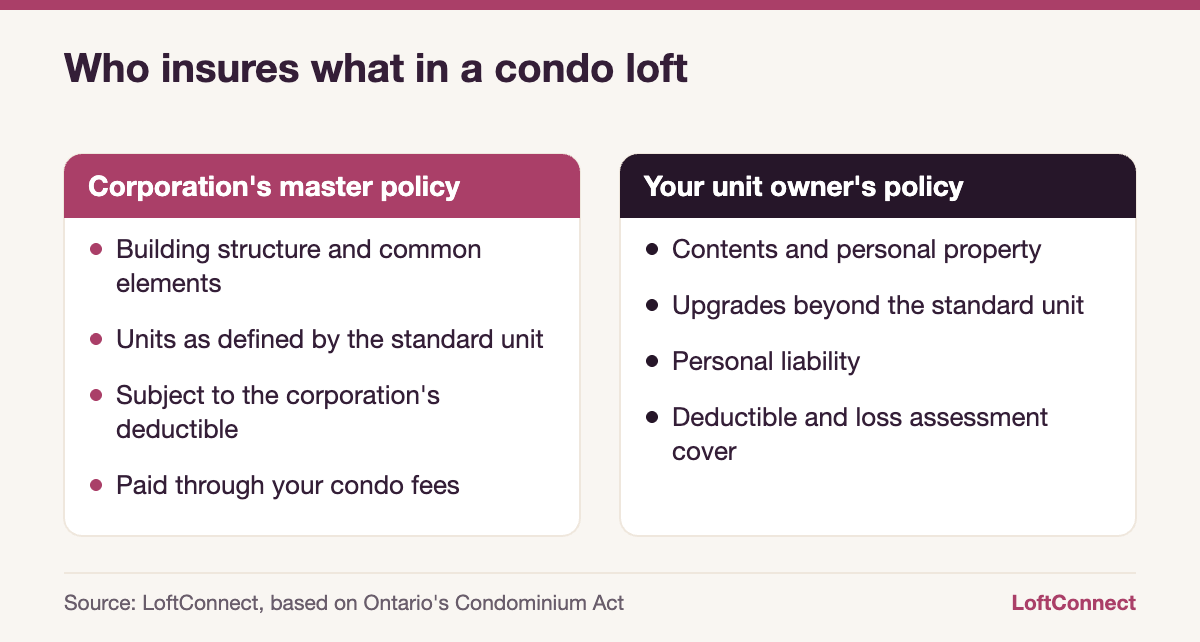
Ontario’s Condominium Act requires the corporation to insure the units and common elements against major perils such as fire and water escape. What counts as “the unit” for insurance is set by a standard unit description, usually in a by-law. Anything you or past owners added beyond that standard, from a custom kitchen to hardwood replacing the original concrete, is generally an improvement you insure yourself.
So when you buy a renovated hard loft, you’re often buying upgrades that the building’s policy doesn’t cover.
Deductibles: the clause loft owners should read first
The corporation’s policy has deductibles, and in many buildings they’re significant, especially for water damage. Many declarations and by-laws make the owner of the unit where damage originated responsible for the deductible, up to the deductible amount, where the declaration provides for it. Check your building’s wording carefully.
Here’s how that plays out. Suppose a supply line fails in your loft and damages units below. If the corporation’s water deductible is $25,000 and the declaration passes it to the originating unit, you could owe up to $25,000. A unit owner’s policy with deductible coverage can respond, but only up to the limit you bought. The number here is an illustration; use the actual deductible in your building’s insurance certificate.
Where to find the numbers
The status certificate package includes a certificate of the corporation’s insurance, as the Condo Authority of Ontario describes. Your lawyer will review it, but read it yourself too and give the deductible figures to your insurance broker. Our status certificate guide shows where they sit.
Why older buildings change the risk
- Plumbing. Original or early-conversion risers and drains can leak. Ask what the corporation has replaced and when.
- Roofs and masonry. Flat roofs and old brick are common sources of water entry in conversions.
- Sprinklers. Lofts are often fully sprinklered, which is good for fire safety, but accidental discharges cause water damage.
- Original materials. Heritage windows, timber and brick can cost more to repair or match, which affects the corporation’s claims and premiums.
- Claims history. Buildings with repeated water claims may face higher premiums and deductibles, which flow into fees.
The reserve fund study and board minutes show whether these risks are being managed. See why loft condo fees vary for how insurance and repairs feed into your monthly costs.
What your unit owner’s policy should include
| Coverage | What it does | Why it matters in a loft |
|---|---|---|
| Contents | Your furniture, equipment, clothing | Art, studio and camera gear may need extra limits |
| Improvements and betterments | Upgrades beyond the standard unit | Renovated lofts often carry tens of thousands in upgrades |
| Personal liability | Damage or injury you cause to others | A leak from your unit can damage several floors |
| Deductible coverage | Your share of the corporation’s deductible | Match the limit to your building’s actual deductibles |
| Loss assessment | Your share of a special assessment after an insured loss | Smaller buildings spread costs across fewer owners |
| Additional living expenses | Hotel or rent while repairs are done | Repairs to older materials can take longer |
Heritage features and renovations
If your loft has original timber, brick or windows that are common elements, the corporation insures them, but repairs in a designated building may need to follow heritage requirements. Our guide to heritage loft renovation rules explains who decides what.
If you renovate, tell your insurer and update your improvements limit. If the work involved an alteration to common elements, the registered agreement sets out who insures it, as this summary of section 98 agreements notes.
Business use, rentals and vacancy
- Live/work and home studios. Standard policies may limit business equipment and liability for visiting clients. Disclose what you do.
- Renting it out. You’ll generally need a condo landlord policy, and your tenant should carry tenant insurance. Our guide to renting out a loft in Toronto covers the rules.
- Vacancy. Many policies restrict coverage if the unit is empty for an extended period. Tell your insurer before long absences.
An insurance checklist for loft buyers
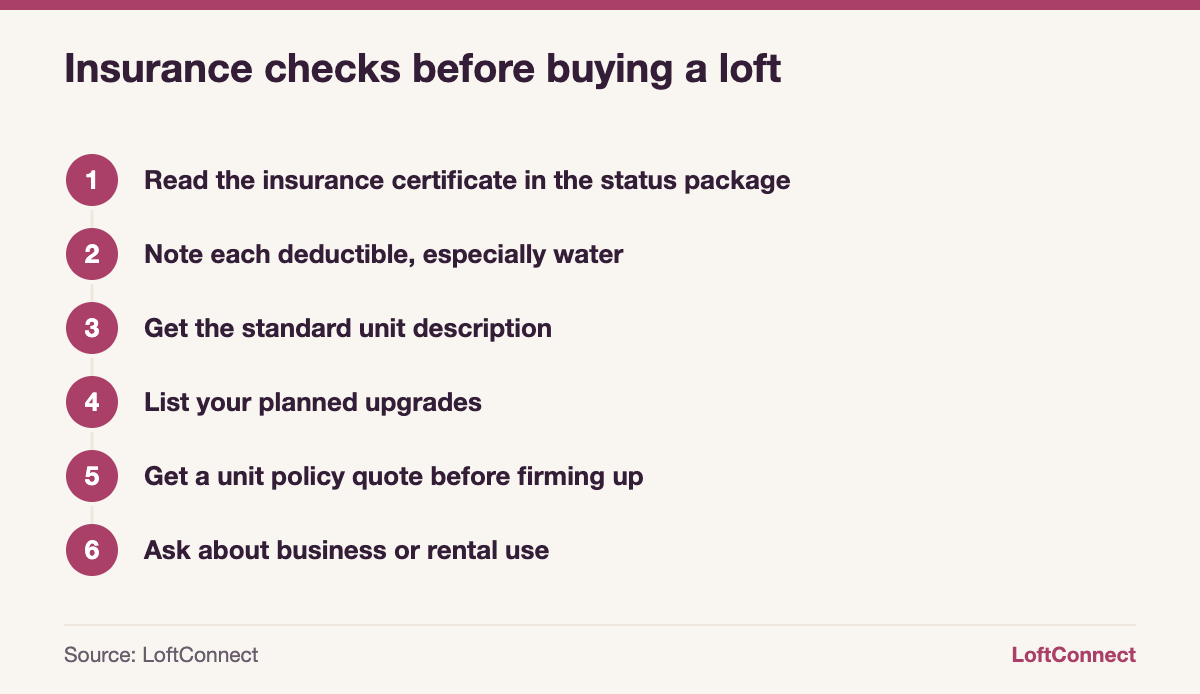
- Read the insurance certificate in the status package and note every deductible.
- Ask for the standard unit description, so you know which upgrades are yours to insure.
- List the unit’s improvements: kitchen, bathrooms, flooring, millwork, lighting.
- Get a unit owner’s quote with deductible coverage matched to the building’s water deductible.
- Ask about any recent claims, premium increases or deductible changes.
- Disclose any business use, rental plans or long absences.
- Install leak detectors under sinks, appliances and the water heater.
Tip: In a loft with an open plan and a single bathroom wall full of plumbing, a few inexpensive water leak sensors near the toilet, sink, dishwasher and laundry can save you a deductible chargeback. Some insurers ask about them, and your downstairs neighbour will thank you.
Frequently asked questions
Do I need insurance if my condo corporation already has a policy?
Yes. The corporation’s policy covers the building and units only as originally defined by the standard unit. It doesn’t cover your belongings, your upgrades or your personal liability, and many declarations make you responsible for the corporation’s deductible if damage starts in your unit. A unit owner’s policy fills those gaps.
What is a standard unit in an Ontario condo?
It’s the description of what a unit includes for the corporation’s insurance, usually set out in a by-law. The corporation’s policy covers the unit to that standard. Anything added beyond it, such as upgraded kitchens, flooring or custom millwork, is generally the owner’s responsibility to insure under their own policy.
Is insurance more expensive for hard lofts?
It can be, mainly through the corporation’s premiums and deductibles, which reflect building age, materials and claims history. Those costs show up in your condo fees and in the deductible you might have to cover. Your own unit policy depends more on your contents, upgrades and the coverage limits you choose.
What happens if water from my loft damages the unit below?
The corporation’s policy typically handles the building damage, subject to its deductible. If the declaration makes the originating owner responsible for the deductible, you may owe it, and your unit policy’s deductible coverage can respond up to your limit. Your liability coverage may also apply. Report the leak to management and your insurer immediately.
Buying a loft in an older building?
Browse hard lofts and Toronto lofts for sale, and build insurance questions into your conditional period.
This article is general information as of October 2026, not legal, tax, mortgage or financial advice. Rules and numbers change, so confirm the details for your situation with a licensed professional.
The newest lofts on the market
Fresh listings, updated every 15 minutes.
 $850,000211 - 625 Queen Street E, Toronto2+1 bed · 2 bath · South RiverdaleCourtesy of CHESTNUT PARK REAL ESTATE LIMITED
 $549,900624 - 200 Manitoba Street, Toronto1+1 bed · 2 bath · MimicoCourtesy of RE/MAX HALLMARK REALTY LTD.
 $729,900603 - 569 King Street E, Toronto1+1 bed · 1 bath · Moss ParkCourtesy of ROYAL LEPAGE REALTY PLUS
 $534,000216 - 8 Dovercourt Road, Toronto1 bed · 1 bath · Little PortugalCourtesy of SAGE REAL ESTATE LIMITED
 $824,900310 - 45 Dovercourt Road, Toronto1+1 bed · 1 bath · NiagaraCourtesy of CENTURY 21 PEOPLE`S CHOICE REALTY INC.
 $499,990528 - 65 East Liberty Street, Toronto1 bed · 1 bath · NiagaraCourtesy of HOMELIFE/MIRACLE REALTY LTD