You can rent out a loft in Toronto, but the rules depend on how. Long-term leases are allowed in most condos and follow Ontario’s Residential Tenancies Act, with rent control applying to units first occupied as homes on or before November 15, 2018. Short-term rentals are only allowed in your own principal residence, capped at 180 nights a year for the whole unit, and many condos ban them anyway. Leave the loft empty and Toronto’s 3% Vacant Home Tax can apply.
Key takeaways
- Toronto short-term rentals must be in the operator’s principal residence and registered with the City.
- Renting your entire home short term is capped at 180 nights a year; renting part of it has no cap.
- Most hard lofts were first occupied before November 15, 2018, so the rent increase guideline applies to sitting tenants.
- A loft left vacant can face a Vacant Home Tax of 3% of its assessed value.
- Your condo’s declaration and rules can restrict rentals further and require notice of any lease.
Can I Airbnb my loft in Toronto?
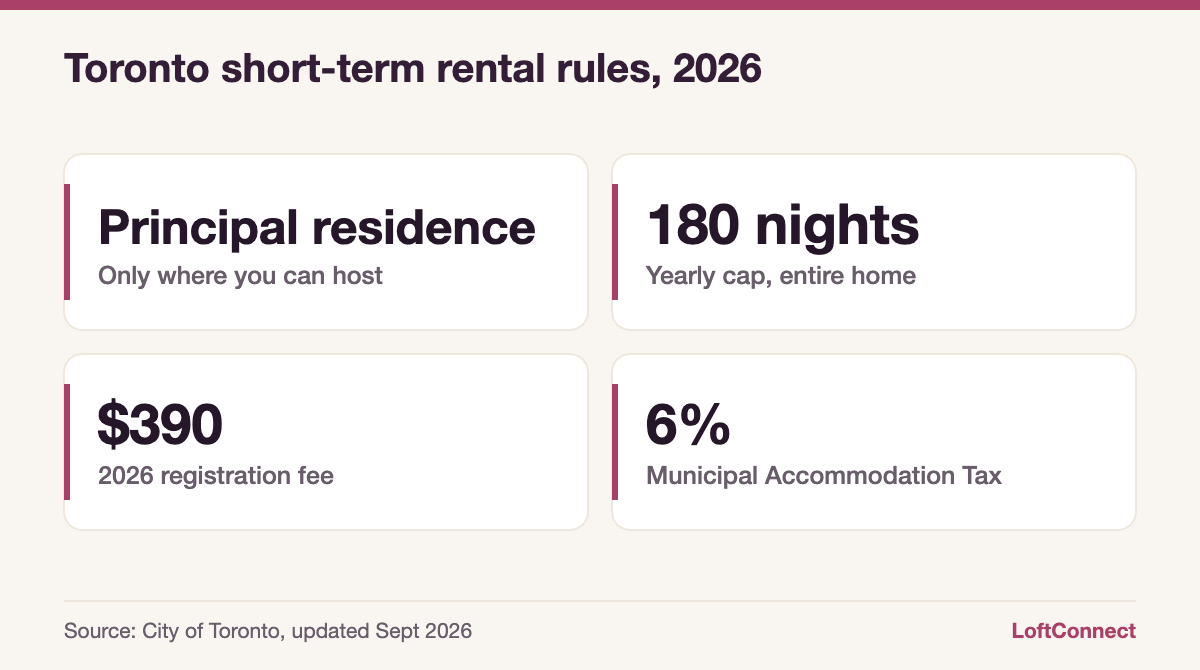
Only if it’s where you live. Under the City of Toronto’s short-term rental rules, updated September 2026:
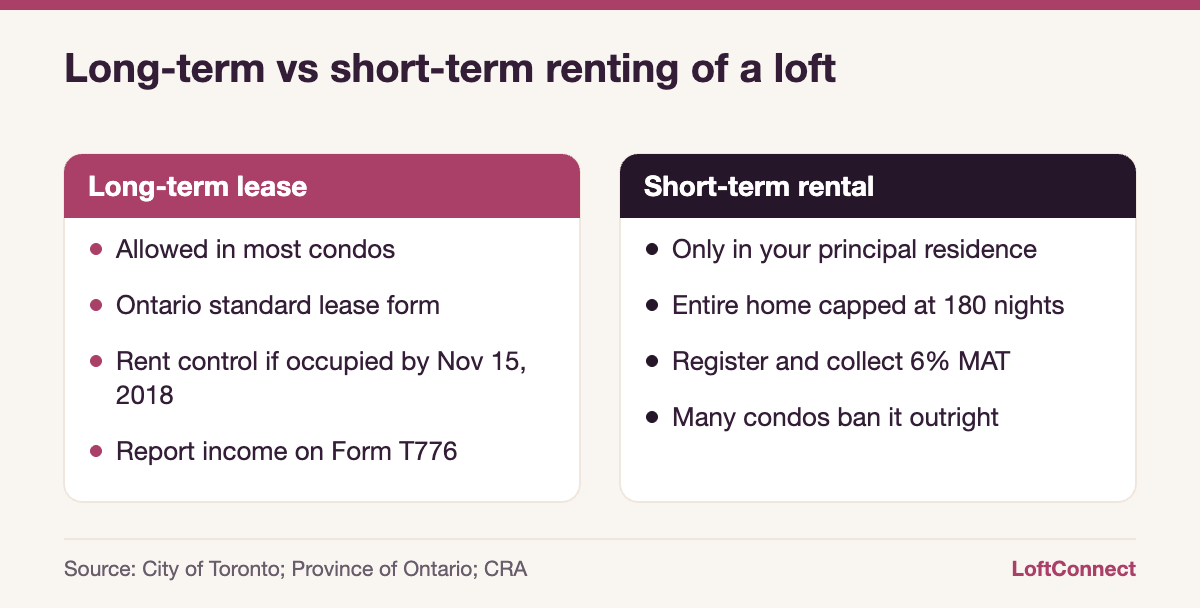
- Short-term rentals (under 28 consecutive days) are allowed only in the operator’s principal residence, with one registration per unit.
- Renting the entire home is capped at 180 nights a year. Renting a room or part of the home while you’re there has no cap.
- The 2026 registration fee is $390.
- Operators must collect the 6% Municipal Accommodation Tax.
- Condo declarations and rules can ban short-term rentals entirely, and many do.
So an investment loft you don’t live in can’t legally be a short-term rental in Toronto. If you do live in it and travel for work, the 180-night cap applies to stays when you’re away and the whole unit is rented.
The tax risk of a non-compliant short-term rental
Since the 2024 tax year, the CRA denies all expenses on short-term rental income for any period the rental doesn’t comply with provincial or municipal rules, such as operating without registration or where short-term rentals aren’t permitted. The CRA’s guidance means you could pay tax on the gross revenue with no deductions for interest, fees or cleaning.
Long-term renting: what applies to lofts
Most loft owners who rent go the long-term route. That means the Residential Tenancies Act, the Landlord and Tenant Board, and Ontario’s standard form of lease for most residential tenancies.
Rent control: why the building’s age matters
Ontario’s annual rent increase guideline limits increases for sitting tenants, and by law it can’t exceed 2.5%. But units first occupied for residential purposes after November 15, 2018 are exempt, as the province’s guideline page explains.
| Loft type | First occupied | Rent increase guideline |
|---|---|---|
| Hard loft in a 1990s or 2000s conversion | Before Nov 15, 2018 | Applies to sitting tenants |
| Soft loft in a building completed in 2015 | Before Nov 15, 2018 | Applies to sitting tenants |
| Soft loft in a building completed in 2022 | After Nov 15, 2018 | Exempt |
| Hard loft converted to homes after 2018 | After Nov 15, 2018 | Likely exempt; confirm with a lawyer |
Rent can generally be reset between tenancies, but evictions are tightly regulated, so a long-term tenant can stay for years at controlled increases. Build that into your plan. Our 2026 loft investment analysis shows why cash flow is already tight.
The Vacant Home Tax and empty lofts
Toronto’s Vacant Home Tax is 3% of the property’s Current Value Assessment and remains in effect. Every owner must declare occupancy status each year, with the deadline on April 30. On a loft assessed at $500,000, the tax would be $15,000.
There are exemptions, including for some situations involving medical care and for developers’ unsold new inventory. If you’re between tenants or renovating for long stretches, check the occupancy rules carefully and keep records.
Condo rules for renting a loft
- Lease notice. Ontario’s Condominium Act requires an owner who leases a unit to notify the corporation, including the tenant’s name and a copy of the lease or a summary.
- Minimum terms. Some declarations set minimum lease lengths or prohibit short-term stays.
- Rules for tenants. Tenants must follow the condo’s rules, and owners remain responsible for their unit.
- Move-in fees and deposits. Many buildings charge for elevator bookings.
Check the declaration and rules before you buy if renting is part of your plan. In a live/work building, also confirm any business-use restrictions, covered in live/work lofts in Toronto.
Insurance and income tax for loft landlords
Tell your insurer the unit is rented. Most owners need a condo landlord policy rather than an owner-occupier policy, and your tenant should carry their own tenant insurance. Rental income is reported on Form T776, where you can deduct eligible expenses such as condo fees, property tax, insurance and mortgage interest on a long-term rental.
Fees are often the biggest expense, so read why loft condo fees vary before you price your rent.
Steps before you rent out your loft
- Read the declaration and rules for leasing restrictions and notice requirements.
- Decide whether the unit falls under rent control based on its first occupancy date.
- Switch to a landlord insurance policy.
- Use Ontario’s standard form of lease and screen tenants carefully.
- Give the corporation notice of the lease.
- File your Vacant Home Tax declaration each year by April 30.
- Set up records for Form T776 and talk to an accountant.
Tip: Lofts rent best when tenants understand what they’re getting. In your listing, state ceiling heights, whether the bedroom is enclosed, how sound travels and what utilities are included. You’ll get fewer viewings and better-matched tenants who stay longer.
Frequently asked questions
Can I rent my condo loft on Airbnb in Toronto?
Only if the loft is your principal residence, you register with the City, and your condo allows it. Renting the entire unit is capped at 180 nights a year, and you must collect the 6% Municipal Accommodation Tax. An investment loft you don’t live in cannot be used as a short-term rental.
Is my loft exempt from rent control?
Only if it was first occupied for residential purposes after November 15, 2018. Most hard loft conversions and many older soft lofts were occupied before then, so the annual rent increase guideline, which can’t exceed 2.5%, applies to sitting tenants. Confirm the first occupancy date before relying on the exemption.
Do I pay the Vacant Home Tax if my loft is between tenants?
Possibly. The tax applies to homes that are unoccupied for more than six months in a year, subject to exemptions, and every owner must file an annual declaration. Short gaps between tenants usually don’t trigger it, but long vacancies or renovations can. Check the City’s current rules and keep records.
Do I have to tell my condo corporation I’m renting out my loft?
Yes. Under Ontario’s Condominium Act, an owner who leases a unit must notify the corporation and provide the tenant’s name and a copy or summary of the lease. Many corporations also have rules about move-ins, elevator bookings and minimum lease terms that you and your tenant must follow.
Buying a loft with renting in mind?
Browse Toronto lofts for sale and check each building’s leasing rules early, or contact us for help comparing buildings.
This article is general information as of October 2026, not legal, tax, mortgage or financial advice. Rules and numbers change, so confirm the details for your situation with a licensed professional.
The newest lofts on the market
Fresh listings, updated every 15 minutes.
 $850,000211 - 625 Queen Street E, Toronto2+1 bed · 2 bath · South RiverdaleCourtesy of CHESTNUT PARK REAL ESTATE LIMITED
 $549,900624 - 200 Manitoba Street, Toronto1+1 bed · 2 bath · MimicoCourtesy of RE/MAX HALLMARK REALTY LTD.
 $729,900603 - 569 King Street E, Toronto1+1 bed · 1 bath · Moss ParkCourtesy of ROYAL LEPAGE REALTY PLUS
 $534,000216 - 8 Dovercourt Road, Toronto1 bed · 1 bath · Little PortugalCourtesy of SAGE REAL ESTATE LIMITED
 $824,900310 - 45 Dovercourt Road, Toronto1+1 bed · 1 bath · NiagaraCourtesy of CENTURY 21 PEOPLE`S CHOICE REALTY INC.
 $499,990528 - 65 East Liberty Street, Toronto1 bed · 1 bath · NiagaraCourtesy of HOMELIFE/MIRACLE REALTY LTD