
Lofts can cost more to heat and cool than standard condos, mainly because high ceilings mean more air to condition and big windows lose heat in winter and let in sun in summer. How much more depends on the windows, the heating system, which way the unit faces and whether utilities are already in your condo fee. The surest way to know is to ask for a year of actual bills before you buy.
Key takeaways
- A 1,000 sq ft loft with 14-foot ceilings has about 56% more air than the same floor area at 9 feet.
- Warm air rises, so high ceilings can leave the living level cool while heat collects overhead.
- Older single-pane or steel windows are often the biggest source of discomfort, and they’re usually common elements.
- Ontario’s electricity prices reset each November 1; the current ones took effect November 1, 2025.
- In some hard lofts heat is included in the fee, which changes the comparison entirely.
Are lofts expensive to heat?
They can be, and the reasons are physical rather than mysterious.
- Volume. 1,000 square feet at 9-foot ceilings is 9,000 cubic feet of air. At 14 feet it’s 14,000 cubic feet, about 56% more.
- Stratification. Warm air rises. In a tall room the warmest air sits near the ceiling, so the thermostat at eye level keeps calling for heat.
- Glass. Large windows lose far more heat than insulated walls, and older windows lose the most.
- Exposure. Corner and top-floor units have more exterior surface. A unit with neighbours above, below and on both sides is shielded by them.
The flip side is that thick masonry walls in many hard lofts store heat and smooth out temperature swings. A well-sealed brick loft with decent windows can be very comfortable.
How loft heating systems differ
You’ll find most of these in Toronto lofts:
| System | Common in | What to know |
|---|---|---|
| Forced air (in-suite furnace or heat pump) | Many conversions and soft lofts | Check age and who maintains it; ducting in tall spaces may need ceiling fans to help |
| Fan coil units fed by central boiler and chiller | Larger soft loft buildings | Heat and cooling may only switch over seasonally; costs often partly in fees |
| Hot water radiators | Some older conversions | Comfortable, quiet heat; often no central air |
| In-floor radiant | Some high-end conversions and townhouse lofts | Even, quiet warmth at floor level, which suits tall rooms; slow to respond |
| Electric baseboards | Some older or smaller buildings | Simple, but every kilowatt-hour shows up on your hydro bill |
What it costs: 2026 electricity math
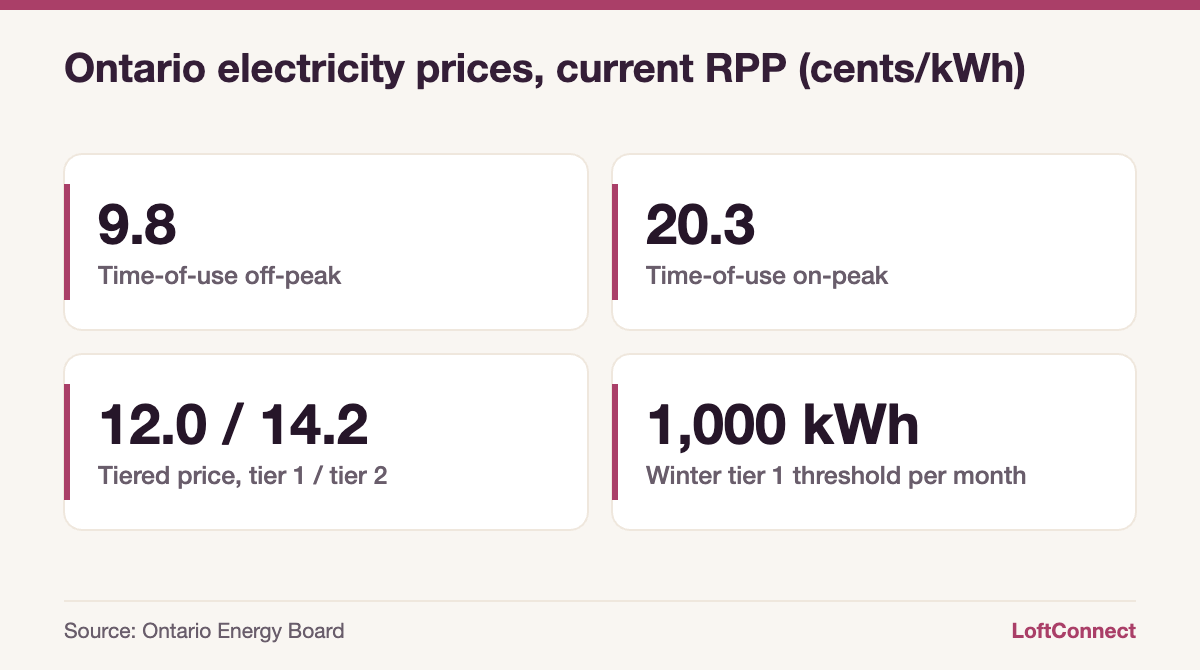
The Ontario Energy Board sets Regulated Price Plan prices once a year on November 1. The current prices, in effect since November 1, 2025, are 9.8 cents per kWh off-peak, 15.7 mid-peak and 20.3 on-peak on time-of-use. Tiered customers pay 12.0 cents for the first 1,000 kWh a month in winter and 14.2 cents above that. New prices will be set for November 1, 2026.
The OEB’s typical household uses about 700 kWh a month, per its 2025 price backgrounder. Suppose a loft with electric heat uses twice that, 1,400 kWh, in a winter month:
- On tiered pricing: 1,000 kWh at 12.0 cents plus 400 kWh at 14.2 cents = $176.80
- On time-of-use, with 65% off-peak, 18% mid-peak and 17% on-peak: about $177.06
- For comparison, 700 kWh on tiered pricing is $84.00
Those are electricity charges only. Delivery, regulatory charges and HST are added, and the Ontario Electricity Rebate is credited on top. The point isn’t the exact bill but the scale: doubling consumption roughly doubles the energy line.
Cooling a loft with big windows
Summer can be harder than winter. South- and west-facing walls of glass let in a lot of solar heat, and hot air pools under high ceilings, especially on top floors.
What helps
- Interior shading. Solar or blackout roller shades cut heat gain before it reaches the room. Cellular shades help in winter too.
- Ceiling fans. Run them counter-clockwise in summer for a downdraft, and on low clockwise in winter to push warm air back down without a breeze.
- Zoning. Closing off a sleeping area with a sliding partition lets you cool a smaller space at night.
- Portable units, carefully. Many condos restrict window units and anything visible from outside, so check the rules.
Windows, films and condo approvals
In most Ontario condos, windows are part of the common elements, so replacing them is the corporation’s decision and cost, funded by the reserve fund. If a building’s windows are near the end of their life, expect that to show up in the reserve fund study and possibly in future fees.
Changes visible from outside, including some window films and exterior shading, usually need board approval. Alterations to common elements need board approval and, typically, a written agreement registered on title, as this Ontario condo law summary of section 98 explains. Ask before you buy anything.
How to judge a loft’s energy costs before you buy
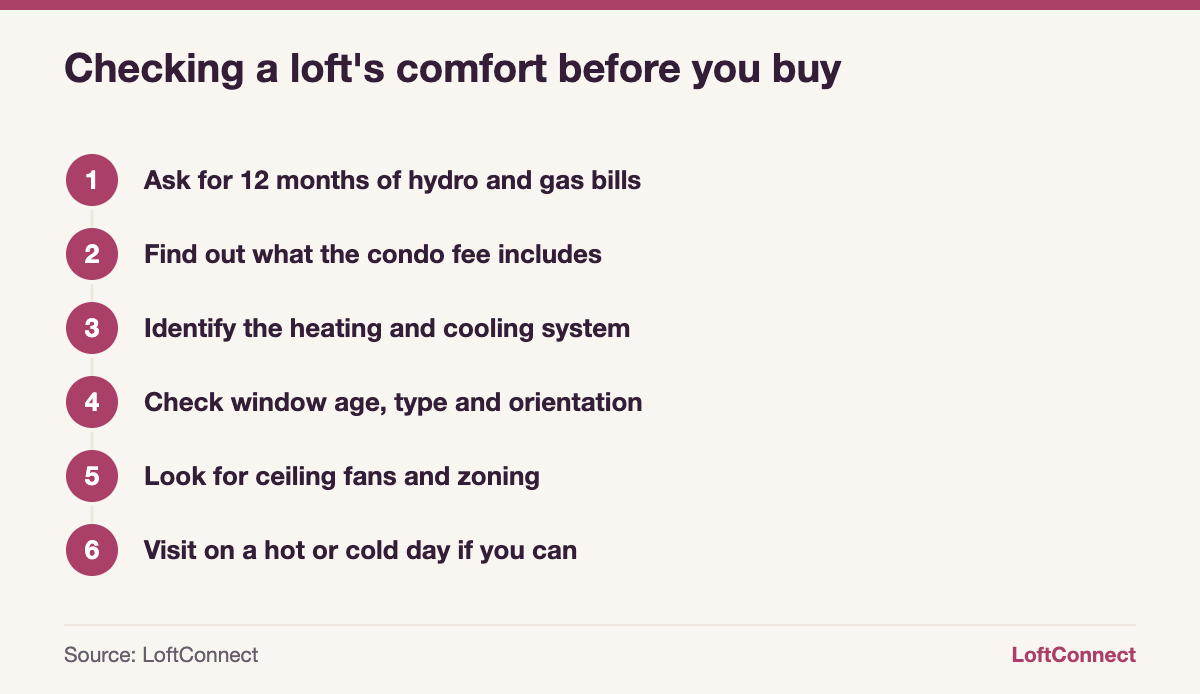
- Ask the seller for 12 months of hydro (and gas, if separately metered) bills.
- Find out what the condo fee includes. Some hard lofts include heat, water or hydro, which makes the fee look high and the bills look low. Our guide to loft condo fees explains how to compare.
- Identify the heating and cooling system and its age.
- Check window type, age and orientation, and look for condensation stains on sills.
- Look up: is there a ceiling fan, a return-air vent high up, or anything to move warm air?
- If you can, visit on a cold or hot day, in the afternoon.
These checks pair well with our nine-point loft buying checklist.
Tip: At a showing, hold your hand near the window frames and the base of the glass. A steady cold draft in October means a chilly January, and it tells you more than the listing’s “oversized windows” ever will.
Hard loft vs soft loft: which is easier to keep comfortable?
Soft lofts are newer buildings built to more recent energy codes, with better-sealed windows and modern mechanical systems, so they’re often easier to heat and cool, though floor-to-ceiling glass can still overheat. Hard lofts vary more. A conversion with replaced windows and good mechanicals can be excellent; one with original glazing and an old system can be drafty. Our hard vs soft loft guide covers the other trade-offs.
Frequently asked questions
Are high ceilings hard to heat?
They take more energy because there is more air, and heat rises away from where you sit. A 14-foot ceiling holds about 56% more air than a 9-foot one over the same floor. Ceiling fans on a low winter setting, radiant floors and good windows reduce the problem significantly.
How much is hydro in a Toronto loft?
It varies widely with size, heating type and what the condo fee covers. A loft with electric heat may use far more than the OEB’s typical 700 kWh a month in winter, while one with heat included in the fee may have modest bills. Ask the seller for a year of actual bills.
Can I replace the windows in my loft?
Usually not on your own. In most Ontario condos, windows are common elements, so replacement is a corporation project funded by the reserve fund. Owners who want changes need board approval and often a registered agreement. Ask the manager whether a window project is planned.
Do ceiling fans help in a loft?
Yes. In winter, run them clockwise on low to push warm air down from the ceiling without creating a draft. In summer, run them counter-clockwise for a cooling breeze. In tall spaces, fans are one of the cheapest ways to improve comfort and reduce how often the heating runs.
Find a loft you’ll be comfortable in year-round
Browse Toronto lofts for sale and ask for utility history on any unit you shortlist. Then add realistic utility costs to your budget in our loft buyer calculators.
This article is general information as of October 2026, not legal, tax, mortgage or financial advice. Rules and numbers change, so confirm the details for your situation with a licensed professional.
The newest lofts on the market
Fresh listings, updated every 15 minutes.
 $850,000211 - 625 Queen Street E, Toronto2+1 bed · 2 bath · South RiverdaleCourtesy of CHESTNUT PARK REAL ESTATE LIMITED
 $549,900624 - 200 Manitoba Street, Toronto1+1 bed · 2 bath · MimicoCourtesy of RE/MAX HALLMARK REALTY LTD.
 $729,900603 - 569 King Street E, Toronto1+1 bed · 1 bath · Moss ParkCourtesy of ROYAL LEPAGE REALTY PLUS
 $534,000216 - 8 Dovercourt Road, Toronto1 bed · 1 bath · Little PortugalCourtesy of SAGE REAL ESTATE LIMITED
 $824,900310 - 45 Dovercourt Road, Toronto1+1 bed · 1 bath · NiagaraCourtesy of CENTURY 21 PEOPLE`S CHOICE REALTY INC.
 $499,990528 - 65 East Liberty Street, Toronto1 bed · 1 bath · NiagaraCourtesy of HOMELIFE/MIRACLE REALTY LTD