
Hard lofts can be noisier than modern concrete condos, but not always. The usual culprits are wood plank floors that carry footsteps, open plans with no doors to stop sound, and hard surfaces like brick, concrete and glass that make rooms echo. A well-converted loft with a concrete structure and good underlay can be quieter than a new tower, so judge the specific building, not the label.
Key takeaways
- There are three kinds of loft noise: from neighbours, from outside, and echo inside your own unit.
- Heavy timber and plank floors generally carry footsteps more than concrete slabs.
- Ontario’s Building Code sets airborne sound ratings between units for new construction (STC 50, and ASTC 47 since 2020).
- Condo flooring rules and approved underlays do most of the work on footstep noise.
- Visit twice, at different times, and read the board minutes for complaints.
Are hard lofts noisy? The three kinds of loft noise
Noise from neighbours
Voices, music and TV travel through walls and floors as airborne sound. Footsteps, dropped objects and chairs scraping travel as impact sound, straight through the structure. In a loft, impact noise is usually the bigger complaint, because many conversions have wood floors over wood structure.
Noise from outside
Lofts often sit in former industrial areas next to rail corridors, streetcar lines or busy nightlife streets. Large older windows let more of that in than modern sealed glazing does.
Echo inside your unit
This one surprises people. Exposed brick, concrete floors, tall ceilings and big windows reflect sound, so a loft can feel loud even when the neighbours are silent. A conversation in the kitchen carries to the bed on the mezzanine because there’s nothing in between to absorb it.
How loft construction affects sound transfer
Every building is different, but the structure gives you a starting clue.
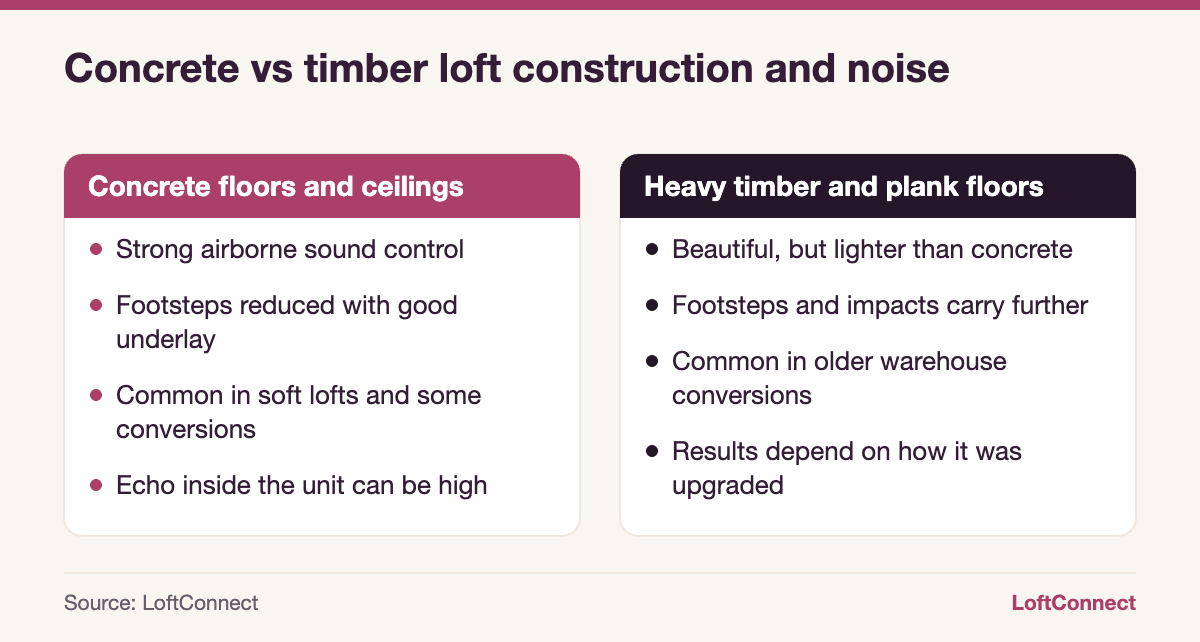
| Construction | Airborne noise | Footstep noise | What to ask |
|---|---|---|---|
| Concrete slab floors and ceilings | Usually well controlled | Good with proper underlay | What underlay is required under hard flooring? |
| Heavy timber with plank decking | Varies with upgrades | Often the weak point | Was a topping, acoustic mat or new subfloor added in the conversion? |
| Wood plank with a poured topping | Better than bare plank | Better, depending on the layer | How thick, and over what? |
| Newer concrete soft loft | Built to recent code | Depends on finish flooring | When was the building permit issued? |
What Ontario’s Building Code requires
For walls and floors between dwelling units, Ontario’s Building Code requires a Sound Transmission Class (STC) of at least 50. Since the 2020 amendments, new projects must also meet an Apparent Sound Transmission Class (ASTC) of 47, which measures sound through the whole assembly, including flanking paths around the wall, unless they build an exactly prescribed assembly. Acoustic consultants at Aercoustics note the newer rules don’t apply to buildings that started construction before 2020.
Two practical takeaways for loft buyers. First, most hard loft conversions were completed under older rules, so performance depends on what the converter did. Second, these ratings deal with airborne sound. Footstep noise is mostly managed through each condo’s flooring rules, which often require board approval and a specific underlay before an owner replaces carpet or installs hardwood.
Open-concept and two-storey lofts
An open plan is the point of a loft, but it means sound moves freely within the unit. A sleeping mezzanine shares its air with the living room below. If one person works late or gets up early, the other will know.
Partial fixes include a sliding glass or solid partition, heavy curtains on a ceiling track, and positioning the bed away from the open edge. If you plan to enclose a space properly, check the condo’s approval process first.
Making a loft quieter
Inside your unit
- Soft surfaces. Large rugs, upholstered furniture, bookshelves and lined curtains cut echo noticeably.
- Acoustic panels. Fabric-wrapped panels or felt baffles on walls or ceilings can be designed to look intentional.
- Door seals and solid doors on any enclosed rooms.
Between you and the neighbours
- Talk to the owner above about rugs before you talk to the board. It works more often than you’d think.
- If you’re replacing flooring, use the underlay your condo requires, or better.
- Persistent problems can go to the board, and since 2022 the Condominium Authority Tribunal can hear disputes about noise under a condo’s rules.
From outside
- Window inserts or secondary glazing can help, but windows are usually common elements, so get approval first.
- Heavy blackout curtains reduce both light and some noise.
How to test a loft for noise before you buy
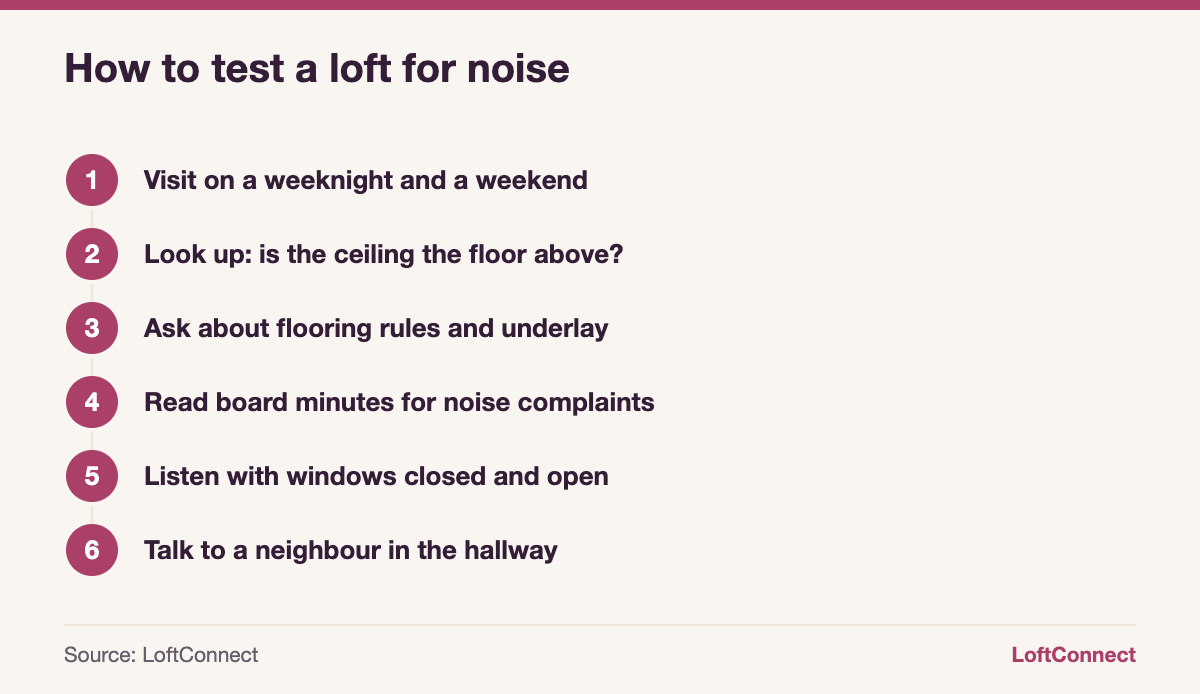
- Visit twice: once on a weeknight after 7 p.m., once on a weekend afternoon.
- Look up. If the ceiling is exposed wood plank, it’s the floor of the unit above, and you’ll hear that unit.
- Ask whether the unit above has hardwood, and what the building’s flooring rules require.
- Ask the seller for recent board minutes and read them for noise complaints. Minutes don’t come with the status certificate, but owners can request records from the corporation.
- Stand by the windows with them closed, then open, at rush hour.
- Check what’s nearby: rail lines, streetcar tracks, bars, loading docks, rooftop mechanical units.
- If you can, chat with a neighbour in the hallway or elevator.
The Condo Authority of Ontario explains what comes with a status certificate, and our status certificate guide shows where noise and flooring rules usually appear. For the building’s other systems, see our loft buying checklist.
Tip: In a timber conversion, the most valuable unit for quiet is often the top floor, since nobody walks above you. If you’re choosing between floors in the same building, that can be worth more than an extra few square feet.
Frequently asked questions
Are hard lofts quieter than condos?
Not as a rule. Concrete condos usually control airborne and footstep noise better than timber conversions, while some concrete-frame hard lofts perform very well. The construction type, the conversion work and the flooring rules matter more than whether a building is called a loft. Visit at busy times before deciding.
What STC rating is required between condo units in Ontario?
Ontario’s Building Code requires STC 50 for walls and floors separating dwelling units. Since the 2020 changes, new projects must also achieve ASTC 47 for the full assembly, unless they use a prescribed design. Buildings that started construction before 2020, which includes most hard loft conversions, were built under earlier requirements.
Can I install hardwood in my loft?
Usually yes, with approval. Many condos require you to apply to the board, use a specified acoustic underlay and sometimes sign an agreement before replacing carpet or flooring. Skipping the process can lead to orders to remove the floor. Read the rules and ask the manager before you buy materials.
How do I reduce echo in a loft?
Add soft, absorbent surfaces: large rugs, upholstered furniture, full bookshelves, lined curtains and acoustic panels or felt baffles. Tall rooms with brick, concrete and glass reflect sound, so even a few large absorbent pieces make a noticeable difference. Place them near where people talk most, like the kitchen and living area.
Find a loft that sounds as good as it looks
Compare hard lofts and newer soft lofts across Toronto, and book a second, evening showing for anything on your shortlist. Comfort matters too, so see our notes on heating and cooling a loft.
This article is general information as of October 2026, not legal, tax, mortgage or financial advice. Rules and numbers change, so confirm the details for your situation with a licensed professional.
The newest lofts on the market
Fresh listings, updated every 15 minutes.
 $850,000211 - 625 Queen Street E, Toronto2+1 bed · 2 bath · South RiverdaleCourtesy of CHESTNUT PARK REAL ESTATE LIMITED
 $549,900624 - 200 Manitoba Street, Toronto1+1 bed · 2 bath · MimicoCourtesy of RE/MAX HALLMARK REALTY LTD.
 $729,900603 - 569 King Street E, Toronto1+1 bed · 1 bath · Moss ParkCourtesy of ROYAL LEPAGE REALTY PLUS
 $534,000216 - 8 Dovercourt Road, Toronto1 bed · 1 bath · Little PortugalCourtesy of SAGE REAL ESTATE LIMITED
 $824,900310 - 45 Dovercourt Road, Toronto1+1 bed · 1 bath · NiagaraCourtesy of CENTURY 21 PEOPLE`S CHOICE REALTY INC.
 $499,990528 - 65 East Liberty Street, Toronto1 bed · 1 bath · NiagaraCourtesy of HOMELIFE/MIRACLE REALTY LTD